Showing posts with label delicacy. Show all posts

Wednesday, 20 July 2016

Blurring The Distinction Between Realisation, Logogenesis And Instantiation

Martin (1992: 536-7):
Field is the contextual projection of experiential meaning and so alongside IDEATION puts at risk the clause rank systems TRANSITIVITY, CIRCUMSTANTIATION and AGENCY, as well as systems generating Numerative, Epithet, Classifier, Thing and Qualifier in nominal group structure and various other group/phrase systems, all of which need to be interpreted as embracing lexis as most delicate grammar; in addition, research into collocation patterns provides an important perspective on field's realisation (see Benson & Greaves 1981, 1992, forthcoming).

Blogger Comments:

[1] This is misleading.  Field is not the contextual projection of experiential meaning.  Field is the ideational dimension of context.  That is, it is application of the theoretical notion of the ideational metafunction to the culture as a semiotic system.

[2] As previously demonstrated, Martin's system of ideation, purported to be a model of experiential meaning on the discourse semantic stratum, is actually a confusion of lexical cohesion (textual metafunction at the level of grammar), lexis as most delicate grammar (lexicogrammatical delicacy), and logical relations between figure elements.

Martin here omits systems of the logical metfunction.  This would have required the inclusion of the discourse semantic system of conjunction, which, as previously demonstrated, is a confusion of clause complex relations (logical metafunction) and cohesive conjunction (textual metafunction), both of which are grammatical systems.

[3] Unhappily, the risk that semiotic systems face is never identified.

[4] To be clear, the clause rank system of transitivity includes the systems of agency and circumstantiation.  Circumstantiation refers to 'circumstantial transitivity' (Halliday & Matthiessen 2014: 758).

[5] 'Systems generating structure' blurs the distinction between axial realisation, logogenesis and instantiation.  The relation between paradigmatic system and syntagmatic structure is realisation.  Structure realises system.  That is, they are in a relation of symbolic identity, with system as Value and structure as Token.

On the other hand, 'generating', in this sense, is modelled in SFL theory as logogenesis, the unfolding of text at the instance pole of cline of instantiation, as features are selected and realisation statements activated (the process of instantiation).

[6] This demonstrates a lack of understanding of the notion of lexis as most delicate grammar — as also demonstrated by its inclusion in Martin's model of experiential discourse semantics.  Lexis as most delicate grammar means that if grammatical networks were to be elaborated to sufficient delicacy, bundles of the most delicate features would specify individual lexical items — just as bundles of articulatory features specify individual phonemes.

[7] To be clear, collocation is a resource of lexical cohesion, and so represents a resource of the textual, not ideational metafunction.

Sunday, 27 September 2015

Confusing Lexis With Grammar

Martin (1992: 301):
Setting aside the fact that for many texts these fine differences in meaning do not matter, it could be argued that the only true synonymy is repetition, including a lexical item's formal scatter (e.g. defeat, defeats, defeated, defeating).  But even here, an item's derivational scatter gives one pause.  Looked at from the point of view of repetition, the difference between synonymy and co-hyponymy can be thought of as an [sic] a kind of scale, graded along the following lines:

same meaning


defeat:defeat
repetition
defeat:defeats
inflectional difference
defeating:defeat
derivational difference
defeat:down
synonym
defeat:trounce
attitudinal difference
defeat:subjugate
co-hyponyms
another meaning


Blogger Comments:

[1] In SFL theory, synonymy is a means of lexical cohesion, where 'a speaker or writer creates cohesion in discourse through the choice of lexical items' (Halliday & Matthiessen 2004: 570).

[2] Synonymy and repetition are both relations of identity; that is what they have in common.  In synonymy, the token and value are different lexical items, whereas in repetition, the token and value are the same lexical item; that is how they differ.  Repetition is not 'the only true synonymy', it is a limiting case of synonymy.

[3] This confuses the two abstractions, lexical and grammatical, of the notion of 'word'.  The variation in the form of words according to their grammatical function is the word as one the ranks in grammatical systems, not the word as lexical item or lexeme.  See Halliday & Matthiessen (1999: 568).

[4] The difference between synonymy and co-hyponymy is that synonyms are similar in meaning, whereas co-hyponyms are members of the same class.  Dogs and cats are co-members of many classes (domestic pets, carnivores), but they are not synonyms.  Cf co-meronyms: parts of the same whole (brain, stomach).

[5] The 'grading' confuses a number of variables, including lexis vs grammar, and experiential vs interpersonal meaning.

[6] The difference between 'defeat' and 'defeating' (note the change in order) is inflectional rather than derivational, except in the comparatively rare case where the latter functions as a nominal.

[7] The words 'defeat' and 'trounce' are also synonyms (experiential meaning), whatever their difference in attitude (interpersonal meaning).

[8] The words 'defeat' and 'subjugate' are also synonyms; a specific class of which their meanings are both hyponyms is less obvious.

Thursday, 24 September 2015

Misconstruing Meronymy As Hyponymy

Martin (1992: 297):
Composition taxonomies organise people, places and things in a given field with respect to part/whole rather than class/subclass relations.  An illustrative taxonomy is outlined in Fig. 5.13, drawing once again on the field of music.  The less delicate systems [Fig. 5.13] focus on the organisation of the swing bands… .  The more delicate systems [Fig. 5.14] break down the players into sections as they were typically organised on stage.

Blogger Comments:

[1] Figure 5.13 starts out as a composition taxonomy — e.g. 'management' and 'personnel' are parts of the whole 'swing band' — but then construes 'female' and 'male' as parts of the whole 'vocalists'; and 'vocalists' and 'players' as parts of the whole 'members'.  That is, it misconstrues hyponyms (types of x) as meronyms (parts of x).

The continuation of the taxonomy in Figure 5.14 is entirely hyponymic — despite being presented as meronymic; e.g. 'rhythm', 'horns' and 'reeds' are misconstrued as parts of the whole 'players'.

[2]  Halliday & Matthiessen (1999: 92):
While the choice of ‘level’ in hyponymic elaboration is the choice in delicacy of categorisation, the choice of level in a meronymic taxonomy is the choice in delicacy of focus.  The focus is typically on the whole (i.e. the most inclusive region within the meronymy) even if a specific part is particularly important.

[3] This misconstrues (what is not) a composition taxonomy as a system network.

Sunday, 13 September 2015

Misconstruing The Difference Between Lexical Item And Grammatical Word

Martin (1992: 290-1):
The distinction within a systemic model between lexical item and word means that in principle cohesion analysis is not tied to orthographic word boundaries.  Phrasal verbs for example can be taken as single lexical items. …
Just how far this notion of a lexical item could be pushed however, remains unclear. …
The problem is that if strong mutual expectancy is used to define lexical items, where does one stop?  If phrasal verbs are treated as single lexical items, then what about Process Range structures
And if Process Range structures, such as these, what about Process and Medium
Or Process and Circumstance (of location, with deixis-less destinations) …
The point is that the distinction between word and idiom is a gradient one, and that distinguishing word from lexical item does not determine where the line between the two is drawn.

Blogger Comments:

[1] This misrepresents the distinction between lexical item and (grammatical) word as a question of how many words make up a lexical item.  Halliday & Matthiessen (1999: 568):
The folk notion of the “word” is really a conflation of two different abstractions, one lexical [lexical item] and one grammatical [word rank].
[2] The view of lexical items presented here is from below (graphology) and the syntagmatic axis (word boundaries).  In SFL theory,  lexical items are specified paradigmatically, by combinations of the most delicate features of lexicogrammatical systems.

[3] In SFL theory, strong mutual expectancy is not used to define lexical items.  This misconstrues lexical items as a syntagmatic relation.  See [2].

[4] Here combined elements of grammatical structures are being used to raise doubts on the (misconstrued) notion of the lexical item.  The purpose of doing so is to justify an approach based on a misconstrued notion of 'field'.  See following posts.

[5] The distinction between word and idiom is irrelevant to the distinction between word and lexical item.  Again, idioms, in Martin's words 'frozen collocations', takes a syntagmatic perspective on the issue.

Friday, 11 September 2015

Misconstruing Semantics As Context

Martin (1992: 289-90):
For the remainder of this chapter it will be assumed that lexical cohesion will be analysed with respect to field oppositions, and that lexical relations can [be] approached from four different perspectives within a systemic functional model.  These perspectives are:
i. from the point of view of mutual expectancy in lexicogrammar (collocation
ii. from the point of view of more delicate options in lexicogrammatical networks (the grammarian's dream)
iii. from the point of view of semantic relations between lexical items in text (lexical cohesion
iv. from the point of view of register specific oppositions (field taxonomies)
An overview of these perspectives is provided in Table 5.2. …

Table 5.2. Lexical relations across planes and strata
Context
Language


DISCOURSE SEMANTICS
LEXICOGRAMMAR
field specific taxonomies
lexical relations (cohesion)
field neutral taxonomies (as delicate grammar)


collocation patterns (lexical sets)


Blogger Comments:

[1] In SFL theory, lexical cohesion is a grammatical resource of the textual metafunction and field is the ideational dimension of context.  Field oppositions and taxonomies are context oppositions and taxonomies, not language oppositions and taxonomies.

[2] In SFL theory, collocation is a type of lexical cohesion and both are located in the lexicogrammar.

[3] Not just in SFL theory, register is a functional variety of language.  Field, on the other hand, is the ideational dimension of context, which is not language, but the culture as a semiotic system that has language as its expression plane.  Field is more symbolically abstract than language.

Perhaps this confusion of register with context arose from the terms 'spoken registers' and 'written registers' in which registers are classified in terms of the context (mode features) they realise — as when Martin later writes: 'though these are less spoken in register' (op cit: 312).

[4]  In SFL theory, "field specific taxonomies" — in Martin's sense — are located at the level of semantics, not context, because they are a way of organising linguistic meaning, not the culture as semiotic.  Such a taxonomy constitutes a lexically oriented domain model, a way of modelling a semantic domain.  Halliday & Matthiessen (1999: 323):
…the semantic correlate of a contextual field is a domain.  When we model the ideational semantics of a particular field, we create a domain model. … Domain models are variants of the general model.  A particular domain model specifies which of the semantic systems in the overall model are activated in a particular contextual field …
[5] As explained in the previous post, field "neutrality" is irrelevant for elaborating grammatical networks into the lexical zone.

[6] In SFL theory, 'lexical set' is opposed to 'collocation'.  That is, it describes the types of lexical cohesion in which the nature of the relation is paradigmatic (repetition, synonymy, hyponymy and meronymy).  Here the term is misapplied to the opposite type of lexical cohesion, collocation, in which the nature of the relation is syntagmatic.

Thursday, 10 September 2015

Relocating Lexis Outside Language

Martin (1992: 289):
This raises the question as to what extent lexis can be treated as most delicate grammar while maintaining a lexicogrammar that is essentially neutral with respect to field. … One way of keeping the grammar neutral would be to locate specialised taxonomies in the register variable field, allowing the grammar to focus on field neutral oppositions.  This would mean for example that the similarity between morphology in linguistics and geology could be brought out in lexicogrammar and the differences between them in field taxonomies; similarly for cover in yachting and sleeping.  And analysts could make a principled decision as to whether they were analysing lexical cohesion with respect to lexicogrammatical taxonomies or field ones, depending on the purposes for which the analysis was designed.

Blogger Comments:

[1] 'Neutrality with respect to field' is irrelevant for elaborating lexis as most delicate grammar.  The lexicogrammar is the overall system of wording potential.  This misunderstanding seems to arise from giving priority to the view from below (e.g. the forms morphology, cover).

[2] This seriously misunderstands the meaning of the stratified model of SFL theory.  Field is not modelled as language; it is a higher level of symbolic abstraction than language: it is the ideational dimension of the culture construed as a semiotic system.  Locating lexical taxonomies outside language is a major category error.

[3] Construing field as a register variable confuses a higher level of symbolic abstraction than language, context, with a functional variety of language, a register.

Construing field variation as a register variable confuses instantial variation (e.g. situation type probabilities) with hyponymy (feature options in systems).

[4] The difference between morphology in the fields of linguistics and geology is characterised in the lexicogrammar — not field — by the different lexical features that specify them as distinct outputs.

[5] This confuses lexical cohesion with lexicogrammatical delicacy, and language with context.

In SFL theory, lexical cohesion is the use of repetition, synonymy, hyponymy, meronymy and collocation to establish non-structural textual relations.  A lexicogrammatical taxonomy, however, is a means of modelling the lexicogrammatical system.  A field taxonomy, on the other hand, is means of modelling the ideational dimension of contextnot lexicogrammar (nor even language).

Wednesday, 9 September 2015

Confusing Textual Cohesion With Experiential Delicacy

Martin (1992: 288-9):
One critical consideration which has been set aside in the discussion of lexical relations to this point is that of field specificity.  In general cohesion analysts have tended not to be very specific about this point.  Categories tend to be illustrated with examples from core vocabulary, which are kept as field neutral as possible: verbs, adverbs and adjectives are favoured over nouns, and "commonsense" nouns are used rather than technical ones.  It is no accident that Hasan chooses action verbs in exploring the grammarian's dream; fields tend to differentiate themselves nominally, through technical lexis, rather than through verbs, adjectives and adverbs.  But even with verbs, the question of field slips in.

Blogger Comments:

[1] This discussion confuses two distinct domains of SFL theory:
  • the grammatical system of lexical cohesion, a nonstructural resource of the textual metafunction that relates lexical items in terms of repetition, synonymy, hyponymy, meronymy and collocation; 

  • the systemic specification of lexical items by extending the delicacy of grammatical networks (experiential metafunction).

[2] In SFL theory, lexical cohesion is a grammatical system concerned with textual relations between lexical items, whereas field is the ideational dimension of context.

[3] These remarks are about extending the delicacy of grammatical networks, while purporting to be about lexical cohesion.

[4] In SFL theory, field variation is modelled as a point on the cline of instantiation at the stratum of context.  For example, field variation is the ideational dimension of situation type variation, where the variation is of the probabilities of field features being selected.

Sunday, 6 September 2015

Falsely Claiming To Have Uniquely Classified Two Lexical Items

Martin (1992: 283):
This brings us to the point where two lexical items have been uniquely classified (define and read) and a step or two in delicacy would isolate several others (e.g. call, name, mean, denote, connote, spell, write, transcribe).

Blogger Comment:

[1] In Fig. 5.5. (ibid.),  the unique classification of define is given as:
  • realise: stratum specific: semantics/grammar : wording: encoding
As demonstrated in the previous post, when the verb define serves as an identifying process, the direction of coding, like all identifying processes, can be encoding or decoding, depending on whether the Token or Value is the Identifier.  The feature [encoding], therefore, does not classify the word define.


[2] Likewise, the unique classification of read is given as:
  • realise: stratum specific: grammar/phon-graphology: encoding
As demonstrated in the previous post, the verb read did not serve as an identifying process in the clause provided.  Rather, it served as a verbal process in a projection nexus.  Accordingly, not one of the features specifying read — [realise: stratum specific: grammar/phon-graphology: encoding] — actually classifies the lexical item.

Saturday, 16 May 2015

Some Of The Theoretical Problems With Participant As The Entry Condition To The System Of Identification

Martin (1992: 155-6):
IDENTIFICATION has the semantic entity participant as its entry condition; its unmarked realisation is a nominal group and the people, places and things this encodes all have the potential to participate as Agent or Medium in clause structure at some point or other in a text.

Blogger Comments:

[1] Participant as the entry condition to the IDENTIFICATION system creates a host of serious theoretical inconsistencies.  For example, 
  • metafunction: participant is an experiential function, whereas IDENTIFICATION is a textual system;
  • delicacy: the features of the system do not elaborate the entry condition, participant, but  (purported) relations between participants; (cf. the entry condition 'clause' for the systems that elaborate the clause);
  • function: participant is the entry condition for circumstantial features (manner/extent).
[2] To be clear, Martin's entire argument to justify IDENTIFICATION as discourse semantic, rather than lexicogrammatical, rests solely on "stratifying with respect to nominal group structure".

[3] To be clear, places are circumstantial meanings, not participants.

[4] To be clear, this does not define any semantic unit, let alone participant, since, through grammatical metaphor, all meaning has "the potential to be construed as an Agent or Medium in clause structure at some point or other in a text."

Sunday, 3 May 2015

Strategically Confusing Delicacy And Realisation

Martin (1992: 119-20):
The second way of avoiding the reference systems outlined above is to use [generalised] reference (Halliday & Hasan 1976: 53-54).  The relationship of these "out" options to the principal reference systems is formulated systemically in Fig. 3.9.  For more delicate realisations of the features [presenting], [undirected] and [comparison] see the networks presented in the course of the description above.

Blogger Comments:

[1] To be clear, as Halliday & Hasan (1976: 53-4) point out, this is generalised exophoric reference, and as such, makes no contribution to the cohesion of a text.  More importantly, Martin violates the principle of stratification by relocating Halliday & Hasan's generalised reference from lexicogrammar to his own discourse semantics, without regard to the different levels of symbolic abstraction that the strata represent.

[2] This strategically confuses two distinct dimension of SFL theory, delicacy and realisation.  More delicate features are not realisations of less delicate features.  Systemic delicacy is a scale of generality (intensive attribution) at one level of symbolic abstraction (stratum), whereas realisation is a relation (intensive identification) between two levels of symbolic abstraction, as between strata, or between axes, or between function and form; see e.g. Halliday & Matthiessen (1999: 144-5).  The confusion is strategic because it falsely implies that Martin has specified how these features are realised.

Friday, 10 April 2015

Why The Argument For A 'Discourse' Semantic Stratum Is Invalid [Augmented]

Martin (1992: 19):
The impetus for stratification provided by semantic motifs, grammatical metaphor and cohesion gives rise to a model in which the discourse semantics both generalises across grammatical resources and accounts for relations between as well as within clause complexes.  The discourse semantics is thus more abstract than, and deals with larger units than, lexicogrammar.

 Blogger Comments:

[1] Only one of the three purported rationâles, grammatical metaphor, provides a valid reason for stratifying the content plane; but grammatical metaphor does not justify a stratum of discourse semantics — merely a stratum of semantics, as in Halliday's original model.  See here.

As already explained in an earlier post, the discussion of semantic motifs confuses delicacy with stratification, and proposes a higher stratum system (attitude) that would be in an incongruent relation with a grammatical subsystem of process types (behavioural, mental and relational).  See here.

The discussion of cohesion provides no reasons for reconstruing cohesion as belonging to a higher level of symbolic abstraction.  The argument rests on separating cohesion from grammar — a false dichotymy — and the false claim: "the main problem with this treatment is that it fails to bring out the continuity of between the structural [taxis] and non-structural [cohesive] resources".  See here.  Note that, even if this were true, it would not justify relocating cohesion at a higher level of symbolic abstraction.

[2] This again confuses delicacy ("generalises") with stratification (symbolic abstraction).  The grammar is "generalised" by its least delicate systems.  A semantics is more symbolically abstract than lexicogrammar, not more general.

[3] Relations between and within clause complexes are already accounted for by the cohesive resources of the grammar.

[4] This has not been demonstrated.  The discourse semantics is not "thus" more abstract than the grammar, because neither generalisation nor syntagmatic extension is the same as symbolic abstraction.

[5] The proposed unit for the discourse semantic system of the textual metafunction, identification, is the participant (op cit: 325), which is smaller than the clause, and inconsistent with SFL theory in terms of metafunction, since the participant is an experiential, not textual, function. 

Similarly, the proposed unit for the discourse semantic system of the experiential metafunction, ideation, is the message part (op cit: 325-6), which is congruently realised by a lexical item, and so is also smaller than the clause. And the term, 'message part', is similarly inconsistent with SFL Theory in terms of metafunction, since the message is a semantic unit that is textual, not experiential, in metafunction.

Moreover, the size of units is irrelevant as a criterion for levels of symbolic abstraction (stratification).

Conclusion:  The case for establishing a 'discourse semantic' stratum has not been made by any of the three purported rationâles.

Saturday, 4 April 2015

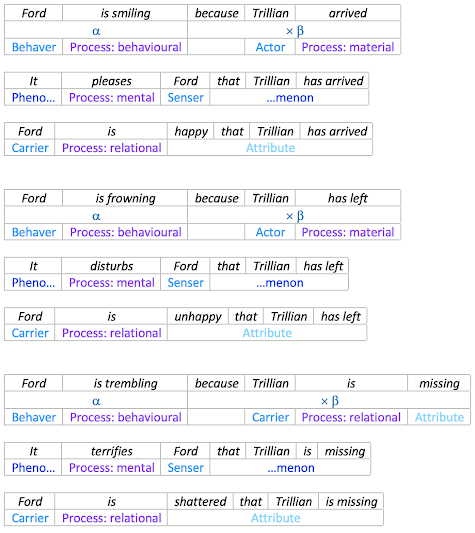
The Problems With Semantic Motifs As A Motivation For Stratification [Revised]

 Martin (1992: 16):

First, there is the question of semantic motifs running through the grammar which cannot be generalised at that level because of their diverse structural realisations.  The following proportionalities can be used to illustrate this point: 
Following Halliday (1985), the first clause in each set is behavioural, the second mental and the third relational — fundamentally different process types.  At the same time, all three clauses construct a relatively uniform, and not unfamiliar disposition for Ford.  One way to generalise across these various realisations of the same disposition is to stratify the content plane, setting up an attitude network realised across process types (with realisations extending into other areas of the grammar as well; for example, adverbial and nominal groups).

Blogger Comments:

To be clear, these 'semantic motifs' are the first of Martin's three reasons for his innovation of stratifying the content plane, despite the fact that the content plane is already stratified into semantics (meaning) and lexicogrammar (wording) in SFL Theory. Cf Halliday (1985: xvii-iii):
[1] To be clear, in SFL Theory, generalisation is a matter of systemic delicacynot stratification. The relation between strata is one symbolic abstraction.

[2] To be clear, it is not true that different structural realisations necessarily warrant systems on a higher stratum. This is because the system of a stratum is already of a higher level of symbolic abstraction than the structures it specifies.

[3]  To be clear, the proportionality here is somewhat reduced, not least because, unknown to Martin, the first instance in each set is a clause complex, not a clause.

[4] To be clear, the "relatively uniform, and not unfamiliar disposition for Ford" in each set is variously construed as:
  • a behavioural Process manifesting a conscious state,
  • a mental Process impinged upon by a Phenomenon, and
  • an Attribute realised by a qualified Epithet.

The rhetorical device deployed here is unnecessary complication — in order to overload the reader. Martin could easily have just contrasted:
  • Ford is smiling [behavioural]
  • Ford is rejoicing [mental]
  • Ford is happy [relational]

[5] To be clear, having presented this as a reason for stratifying the content plane, Martin does not set up the proposed attitude network, and the issues are not raised again in the entire book.