Saturday, 25 April 2015

Martin's MOOD Network For Clauses Realising SPEECH FUNCTION [New]

Martin (1992: 40-1, 91n):
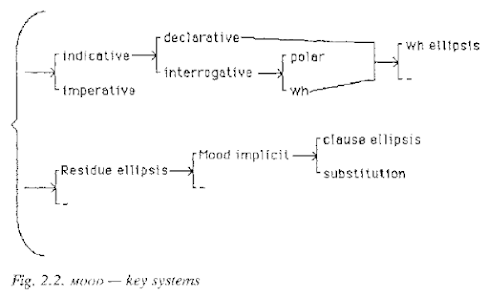
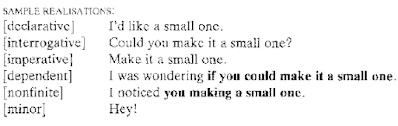
The MOOD network underlying this definition is presented below, along with examples of realisations for terminal features. [Ventola's 1988a criticisms of the unit proposed will be taken up in 2.3 below.] 

² The I/T superscript notation shows that dependent/embedded clauses are declarative by default; according to this network projected proposals have both nonfinite (I asked him to come) and dependent (I asked him if he could come) realisations.

Blogger Comments:

[1] To be clear, this MOOD network falsely proposes that all dependent and embedded clause are finite. This is falsified by Martin's own example I noticed you making a small one which features a nonfinite embedded clause. Halliday & Matthiessen (2014: 171):
Whether they are dependent or downranked, ‘bound’ clauses may be either ‘finite’ or ‘non-finite’.
As Halliday & Matthiessen (2014: 23-4) explain:
A major clause is either indicative or imperative in MOOD; if indicative, it has a Finite (operator) and a Subject. An indicative clause is either declarative or interrogative (still in MOOD); if declarative, the Subject comes before the Finite. An interrogative clause is either yes/no type or WH-type; if yes/no type, the Finite comes before the Subject; if WH-type, it has a Wh element.

[2] To be clear, Martin is concerned here with determining the grammatical unit that realises a proposition or proposal, despite the fact that Halliday had already identified the unit as the clause in its interpersonal guise. Martin has determined that only clauses "selecting independently for mood" realise these major speech functions, but falsely claims that this excludes dependent and embedded clauses; see previous post.

Essentially, Martin here confuses speech function with arguability. Dependent and embedded clauses can realise propositions and proposals; it's just that, in such forms, they are presented as less arguable than propositions and proposals realised by ranking independent clauses.

[3] This is misleading, because it is untrue. To be clear, this network says nothing whatsoever about projected proposals. Moreover, non-finite vs dependent is a false dichotomy: both projected clauses are dependent, the first being non-finite, the second finite. Note also that the non-finite projected clause is simply to go, because, in both projection nexuses, him serves as the Receiver of the projecting clause I asked him.

Misrepresenting Speech Function And Mood [New]

Martin (1992: 40):
The question of how many layers of meaning to recognise raises the problem of units: just what unit is it to which speech function is being assigned? Is for example the response Yes, I would, thank-you, but make it a small one. one speech act or two (or more)? Given what has been stressed to this point about the grammar making available resources for structuring dialogue the most appropriate unit would appear to be a clause selecting independently for MOOD. This rules out the embedded and hypotactically dependent clauses illustrated below:
They loved the team that won. (defining relative)
They defeated whoever they met. (nominalised wh clause)
They watched Manly winning. (act)
It pleased them that Balmain lost. (fact)
They wondered if they'd win. (hypotactic projection)
They won, which surprised them. (hypotactic expansion)
But it does admit paratactically dependent clauses, which do select independently for MOOD. Note the variation in MOOD possible after but, showing that the but is introducing a new move:
Yes, I would, thank-you, but make it a small one.
Yes, I would, thank-you, but I'd like a small one.
Yes, I would, thank-you, but could you make it a small one?


Blogger Comments:

[1] As previously explained, Martin misunderstands all strata as "layers of meaning" (even phonology!), because he confuses strata (meaning-wording-sounding) with semogenesis ("all strata make meaning").

[2] This is a non-sequitur. The number of strata ("layers of meaning") has no bearing on "the problem of units", since the latter is only concerned with one stratum, irrespective of the number of strata.

[3] To be clear, Halliday (1985: 68) "assigns" speech function to the clause as interact or exchange.

[4] To be clear, this instance involves two major speech functions:
Yes, I would [statement]
but make it a small one [command] 
[5] Although it is true that such clauses are presented as presumed rather than negotiable (Halliday & Matthiessen 2014: 172), embedded and dependent clauses can realise speech functions, and can "select independently" for MOOD. For example, in:
Did anyone see [[ if the policeman shot him ]]? 
the ranking interrogative clause realises a question, whereas the rankshifted declarative clause realises a statement; and in:
Was anyone here || when the policeman shot him
the dominant interrogative clause realises a question, whereas the dependent declarative clause realises a statement. Other combinations are, of course, possible, as demonstrated by the imperative clause realising a command and declarative clause realising a statement in:
Don't shoot every policemen just because one of them is a murderer.
Moreover, in an exchange, an interlocutor can respond to a dominant clause, dependent clause, or embedded clause:
Robin said that Lise saw Tom cheating at cards.
— He said no such thing! (reply to dominant clause)
— She couldn't have! (reply to dependent clause)
— But he wasn't! (reply to embedded 'act' clause)

Confusing Semogenesis And Stratification

Martin (1992: 40):
It should also be noted in passing that in the model being developed here both grammar and discourse semantics make meaning. Levinson (1983: 290) comments that the first move in the following text is both "a question and an offer, as indicated by the response".
Would you like another drink?
— Yes, I would, thank-you, but make it a small one.
This is just what would have been predicted by the model developed to this point. Grammatically the first move is a demand for information (interrogative) while semantically it offers goods (Offer); both MOOD and SPEECH FUNCTION contribute a layer of meaning to the clause.

Blogger Comments:

 [1] It is true that both grammar and semantics make meaning — making meaning is semogenesis.  However, this is quite distinct from the stratification of content plane as meaning (semantics) and wording (lexicogrammar), which construes two levels of symbolic abstraction in an intensive (elaborating) identifying relation.

[2] Grammatically, the first move is an interrogative, which is a congruent realisation of a demand for information (question) at the level of semantics.  However, this interrogative clause realises an offer.  Offers are not grammaticised in the mood system and are realised by interrogatives, declaratives or imperatives, depending on the tenor (context) being realised.

[3] This requires clarification.  The mood of a clause, at the level of wording (lexicogrammar), realises speech function, at the level of meaning (semantics).  The meaning of a clause consists of the semantic choices that the grammatical choices realise.  The clause itself is at the level of wording, not meaning.

Friday, 24 April 2015

Blurring Context And Material Setting

Martin (1992: 39-40):
The final set of factors to be taken into account when determining speech function are considerations of context.  Can you open this window? when inspecting a property is likely to be heard differently than when sitting in a stuffy room.  Field, mode, tenor, genre and ideology are all relevant as participating levels of semiosis; it is not possible simply to map speech function directly from 'words on the page'.

Blogger Comments:

[1] This blurs the distinction between context (the field of property inspection) and material setting (a stuffy room).  The context is the semiotic system that is realised by language.  In these instances, the speech function realised by the interrogative clause — question or command— varies with the situation being realised in language.

[2] While field, tenor and mode are metafunctional systems of a level of semiotic systems — the stratum of context — genre, as the name suggests, is a type of semiotic system.  A type of x is not a level of x.  A type of bird is not a level of bird.

[3] It is worth clarifying that the four most general speech functions are defined in terms of the cross-classification of giving vs demanding and information vs goods-&-services, and that three of these have congruent realisations in the mood system — the level of wording.  Metaphorical renderings can be identified by testing the mood choice against the speech function cross-classification.  Congruent and metaphorical renderings realise, and construe, different tenor values at the level of context.

Thursday, 23 April 2015

Misunderstanding Modality In Responses To WH- Interrogatives [New]

Martin (1992: 39):
The one clause type to which the notion of negotiation through grading does not transparently apply is the wh interrogative. One might argue that in an adjacency pair like the following, the response simply supplies the missing experiential meaning; grading is not an issue:
What do you reckon would be good for a five-year-old kid?
— Fairy tales.
Note however that the elliptical response does take over the degree of probability coded in the wh interrogative; it's [sic] full form is She would like fairy tales, with modality probable, as opposed to possible or certain. The actual answer to this question is taken up in 2.8 below (text 2) and demonstrates that interlocutors are prepared to negotiate modality in the context of wh interrogatives where they feel uncomfortable with what an elliptical response might imply: She'll like fairy tales, does she? The nonellipitical reply enables its speaker to adjust modality in the tag.


Blogger Comments:

[1] To be clear, this is all utter nonsense. The grading of modality in responses to WH- interrogatives is not at all problematical, as demonstrated by
What do you reckon would be good for a five-year-old kid?
— Fairy tales, possibly/probably/certainly. (elliptical)
— She'd possibly/probably/certainly like fairy tales. (non-elliptical)

[2] To be clear, because the Mood tag reprises the Finite element, the only way to "adjust modality in the tag" is to first "adjust" it in the Finite:
What do you reckon would be good for a five-year-old kid?
— She could like fairy tales, couldn't she? (low)
— She would like fairy tales, wouldn't she? (median)
— She must like fairy tales, mustn't she? (high)
Cf
What do you reckon would be good for a five-year-old kid?
— She'll possibly like fairy tales, won't she? (low)
— She'll probably like fairy tales, won't she? (median)
— She'll certainly like fairy tales, won't she? (high)

Using Modality To "Determine" Speech Function [New]

Martin (1992: 38-9, 91n):
A second set of evidence relevant to determining speech function is evidence from the co-text, either through the presence of one of the indexical markers noted above in an adjacent interact, or through the expression of gradations within probablity, usuality, inclination and obligation. Halliday (1985a:335) associates degrees of MODALISATION (probability and usuality) with propositions and degrees of MODULATION (inclination and obligation) with proposals; and within proposals, inclination is associated with Offers and Response Offers to Commands and obligation with Commands and Acknowledge Offers.
Examples of this grading in the context of the adjacency pairs considered to this point are provided below.
OFFER ^ ACKNOWLEDGE OFFER (obligation)
Shall I mark them then?
— You're required/supposed/allowed to.

COMMAND ^ RESPONSE OFFER TO COMMAND (inclination)
Get me a drink, would you?
— I'm willing/keen/determined to.

QUESTION ^ RESPONSE STATEMENT TO QUESTION (probability)
Will she win then?
— Possibly/probably/certainly she will.

STATEMENT ^ ACKNOWLEDGE STATEMENT (usuality)
She wins then.
— Sometimes/usually/always¹ she does.
The presence of realisations along these scales (with positive and negative polarity as outer poles), including their metaphorical variants (see Halliday 1985a:336), provides additional evidence for assigning speech function to grammatical classes. The metaphorical realisation of inclination I'd love to in the following pair, clearly associates it with exchanging goods and services, not information:
Why don't you get us a beer?
— I'd love to.
Similarly the scale of usuality associates the first pair below with the negotiation of propositions, while that of inclination implies the negotiation of a service.
Can you open this window?
— Sometimes/usually/always.

Can you open this window?
— I'm willing/keen/determined to.

¹ Always would of course be realised between Subject and Finite (i.e. she always does).
 
Blogger Comments:

[1] This is very misleading indeed. To be clear, here Martin is continuing the fiction that he is establishing SPEECH FUNCTION as a semantic system, despite the fact that Halliday's SPEECH FUNCTION is already a semantic system, as part of the more general fiction that he is in the process of stratifying the content plane into semantics and lexicogrammar, despite the fact that this stratification was proposed in his chief source, Halliday & Hasan (1976: 5):
[2] To be clear, here Martin is trying to establish SPEECH FUNCTION as a semantic system by arguing 'from below': how it is expressed. This is opposite to SFL methodology, which takes the view 'from above': the meaning that is expressed.

[3] To be clear, this misrepresents Halliday (1985: 335), who actually wrote:
[4] This is misleading, because it is not true. Expressions of MODALITY do not "provide evidence for assigning speech function to grammatical classes". On the contrary, Halliday (1985: 335) uses an already "determined" SPEECH FUNCTION to differentiate MODALITY into MODALISATION and MODULATION.

[5] This is misleading, because positive and negative polarity are not the outer poles of modality. Modality lies between these poles, but excludes them.

[6] To be clear, what can associate expressions of inclination with the exchange of goods-&-services, not information, is their being responses to demands for goods-&-services, not information. Such expressions are no identifier of the commodity being exchanged because the same expressions can be used in responses to demands for information, not goods-&-services:
Would you like to be a millionaire?
— I'd love to.
— I'm willing/keen/determined to.

[7] Similarly, expressions of usuality are no identifier of the commodity being exchanged because they can be used with goods-&-services as well as information:

Obey the rules, whatever your personal ethics!
— sometimes/usually/always

[8] To be clear, always can occur in any position, depending on textual considerations:

She always does (least marked: interpersonal Theme)
She does always (focus of New information)
Always she does (most marked: focused interpersonal Theme)

Misrepresenting Hasan's Work On Speech Function [New]

Martin (1992: 37-8):
Beyond this, the most significant work in the area has been undertaken by Hasan (forthcoming), working on the category of Offer. Her strategy is to extend the SPEECH FUNCTION network in delicacy to the point where it makes more categorical predictions about the realisation of discourse semantics in lexicogrammar. As a first step Hasan adds the system [conclusive/nonconclusive] to the SPEECH FUNCTION systems noted above. This allows her to distinguish between Offers which accompany the handing over of goods or performance of a service (proffers) and Offers which foreshadow such {pre-offers). …
But it is clear that the realisation relationship between discourse semantics and lexicogrammar has been considerably clarified simply by taking one step — subclassifying [giving/goods & services] exchanges as [conclusive/nonconclusive]. …
It provides a mechanism for systematically relating SPEECH FUNCTION to MOOD, and at the same time establishes a set of SPEECH FUNCTION classes that is clearly limited, and at the same time indefinitely extendable (through the scale of delicacy).


Blogger Comments:

[1] This is misleading. The term 'discourse semantics' here gives the false impression that Hasan is using Martin's model — and so: endorsing it — whereas, in fact, she is using Halliday's previously devised model of semantics.

This attempted deception is aided by Martin's citing of Hasan's paper as (forthcoming), despite the fact that it has been variously dated to 1985 and 1987 — 5-7 years before Martin's publication. 

Together, these two misrepresentations conspire to conceal the fact that the content plane was stratified into lexicogrammar and semantics before Martin came along to try and take credit for it.

[2] This is misleading. Hasan's work is concerned with extending the delicacy of an already established SPEECH FUNCTION system on the already established stratum of semantics, not with "systematically relating SPEECH FUNCTION to MOOD". The implication here is that the content plane is only now being carried out, here in this work, by Martin, in drawing on the work of others.

[3] Here once again Martin mistakes systemic features for classes.

Trying To Classify Speech Function 'From Below' [New]

Martin (1992: 36):
As far as determining speech function is concerned, there are a number of factors to take into account. First of all, there are several indexical markers which clearly distinguish proposals from propositions. These include please, kindly, allright, okay and thank-you. Please and kindly are found in Commands, allright and okay in Response Offers to Commands and thank-you in responses to Offers or Commands.
Could I have a midi [middy] of Coopers, please?
Okay.
Thanks.
Beyond this, it is difficult to find unique grammatical criteria for recognising very general categories such as Offer, Command, Statement and so on.


Blogger Comments:

[1] To be clear, here Martin is trying to argue semantic distinctions 'from below' — in terms of grammatical expressions. This is the direct opposite of the methodology of SFL Theory, which gives priority to the view 'from above' — the meanings that are expressed. See the previous post.

[2] This is misleading. To be clear, three of the four primary speech functions can be recognised by their congruent grammatical realisations:

  • commands realised in imperative mood,
  • statements realised in declarative mood, and
  • questions realised in interrogative mood.

Misrepresenting The Realisation Of Speech Function In Mood [Revised]

Martin (1992: 36):
To this point a model has been outlined in which SPEECH FUNCTION (discourse semantics) has been stratified with respect to MOOD (lexicogrammar) on the content plane.  This immediately raises two questions: (i) the determination of speech function in the absence of a one to one correlation between general SPEECH FUNCTION categories and those of MOOD; and (ii) the nature of the units to which speech function is assigned.

Blogger Comments:

[1] This is very misleading indeed. On the one hand, it gives the false impression that Halliday's system of SPEECH FUNCTION was not already a semantic system, and not already "stratified with respect to MOOD (lexicogrammar) on the content plane" before Martin came along to try and take the credit.

On the other hand, it gives the false impression that Martin has provided argument that SPEECH FUNCTION is specifically a discourse semantic system, whereas, in fact, no such argument has been made. Moreover, as previously demonstrated, the "argument" that has been made confuses the non-structural textual system of ELLIPSIS-&-SUBSTITUTION with the structural interpersonal system of MOOD.

[2] To be clear, the absence (or presence) of a "one to one correlation between general SPEECH FUNCTION categories and those of MOOD" has no bearing on the determination of speech function. Each of the four categories realises the feature bundle that specifies it:
  • 'statement' realises [give, information];
  • question' realises [demand, information];
  • 'offer' realises [give, goods-&-services];
  • 'command' realises [demand, goods-&-services].
In other words, if the meaning is 'give information' etc., then the speech function is 'statement' etc.

[3] To be clear, Halliday (1981) identifies the semantic unit "to which speech function is assigned" as a move in an exchange. Halliday (2002 [1981]: 240):
Each clause is in this sense a kind of gift, one move in an exchange, symbolised by the change of perspective from me to you.

Wednesday, 22 April 2015

Serious Problems With Martin's Mood System [New]

Martin (1992: 34, 35):
The MOOD systems considered to this point are outlined below (Fig. 2.2)…

Blogger Comments:

To be clear, there are several serious flaws with Martin's MOOD network that make it entirely untenable. 

Firstly, it misrepresents a non-structural textual grammatical system, ellipsis-&-substitution, as part of the structural interpersonal grammatical system of MOOD. Martin later (p100-1)) compounds his error by relocating this "interpersonal" system back to the textual metafunction in his system of IDENTIFICATION on his stratum of discourse semantics. That is, Martin incongruously claims that ellipsis-&-substitution functions interpersonally at the level of grammar, but textually at the level of discourse semantics.

Secondly, the upper network bizarrely proposes that a clause can be both a declarative and a WH- interrogative, and such a clause has the option of WH- ellipsis, which, contrary to Martin's claim, has not been "considered to this point". To be clear, the selection of WH- ellipsis is limited to WH- clauses.

Thirdly, the lower network bizarrely proposes that 
  • mood ellipsis ("implicit") is a subtype of residue ellipsis,
  • clause ellipsis is a subtype of mood ellipsis, and
  • substitution is a subtype of mood ellipsis.

Strategically Misrepresenting The Relation Between Speech Function And Mood [New]

Martin (1992: 34):
Following Halliday (1984a) the semantic inventory of interacts outlined above can now be expanded into four pairs, which will be referred to provisionally, following work in ethnomethodology (e.g. Schegloff & Sacks 1973), as "adjacency pairs":

The grammar then makes available resources for tying an initiation to a response (ellipsis and substitution) and for orienting the exchange to goods and services or information and to giving or demanding (declarative, interrogative and imperative). These resources do not however stand in any biunique relation with a particular move in dialogue, so two levels of analysis are needed to relate system and text.


Blogger Comments:

[1] To be clear, Halliday (1985: 69) provides two types of response, expected vs discretionary, with different terms for the expected responses of offers (acceptance), commands (undertaking) and questions (answer), stipulating that only the last of these is essentially a verbal response:

[2] To be clear, ignoring the fact that there may be no verbal response to offers, commands and statements, and so no adjacency pairs, the tying of an initiation to a response by ellipsis-&-substitution is a cohesive tie, which is a resource of the textual, not the interpersonal metafunction. See Halliday (1985: 295-302).

[3] This is misleading. The grammatical MOOD selections (declarative, interrogative and imperative) realise selections in semantic SPEECH FUNCTION systems of COMMODITY (goods-&-services vs information) and INITIATING ROLE (giving vs demanding). 

However, if Martin had used the word 'realise', it would have disclosed the fact that the content plane had already been stratified by Halliday — a fact he is trying to keep from the reader — since realisation is the relation between strata.

[4] This is misleading. With the exception of offers, there is a "biunique" relation between SPEECH FUNCTION selections (semantics) and MOOD selections (grammar) except in the case of interpersonal metaphor. It is grammatical metaphor that motivates the stratification of the content plane into semantics and lexicogrammar (Halliday & Matthiessen 1999: 237), which is the main reason why Halliday stratified the content plane before Martin came along to try and take the credit.

Using A Textual Grammatical System To Argue For An Interpersonal Semantic System [New]

Martin (1992: 33-4):
Furthermore, as can be seen from the examples above, the relevance of the co-text is also grammaticalised in English. The relevant systems have to do with clause ellipsis and substitution and are described in detail in Halliday and Hasan (1976). There are two major patterns to be considered. The first can be established with respect to the more general MOOD functions Mood (including Subject, Finite and Mood Adjuncts) and Residue (including Predicator, Complement and other Adjuncts) and illustrated as follows:
Get me the new one, please. — Allright, I'll get it for you.
Get me the new one, please. — Allright, I will Residue.
Get me the new one, please. — Allright Mood Residue.
The first response (Allright, I'll get it for you.) is full, though potentially elliptical. The second (Allright, I will.) ellipses the Residue. The third (Allright.) ellipses both Residue and Mood functions. Alternatively, the Mood and Residue functions together may be substituted with so or not.
Will he make it? — Maybe so.
Will she win it? — Perhaps not.
The second pattern is found in the environment of wh interrogatives of both the first order and second order (echo) types; again, both elliptical and potentially elliptical structures are found:
Which is the new one? — This one's the new one.
Which is the new one? — This one.
This is the new one. — Which one's the new one?
This is the new one. — Which one?
As before, there is no one to one relation between grammatical class and discourse function. Responses may be either elliptical or not, as illustrated. In addition, elliptical clauses may initiate dialogue, with ellipsed information typically recoverable from the non-verbal context:
//2 Coming? // — Yes, I am.
//1 Leaving now. // — Oh, are you?


Blogger Comments:

[1] To be clear, this is nonsensical. The "relevance of the co-text" cannot be "grammaticalised". Grammaticalisation is essentially a move from the lexical end of lexicogrammar to the grammatical end, as when 'content words' become 'function' words.

[2] To be clear, Martin is here arguing that there is no 'one to one relation' between interpersonal semantics and interpersonal lexicogrammar. This would require demonstrating that there is no 'one to one relation' between the selection of SPEECH FUNCTION features and their realisation in the selection of MOOD features. However, instead, Martin presents only textual systems of the grammar, ellipsis-&-substitution, and does so without regard to the semantic systems they realise

Moreover, Martin cannot relate ellipsis-&-substitution to his interpersonal semantics because he subsumes ellipsis-&-substitution within his textual system of IDENTIFICATION (p100-1),  his rebranding of Halliday & Hasan's cohesive reference.

[3] Again, Martin misunderstands grammatical functions — here: ellipsis-&-substitution — as grammatical classes (forms).

Confusing Context With Co-Text And Material Setting [Revised]

Martin (1992: 33):
Evidence for the fact that the different grammatical classes are performing a related discourse function comes from their context: from their co-text — the inclusion of please and the reply allright; and from the context of situation, where one might well observe goods being exchanged.

Blogger Comments:

[1] Here again Martin misunderstands grammatical functions (MOOD system features) as grammatical classes.

[2] Here Martin confuses the SFL notion of context — the culture as a semiotic system — with the co-text (language) and the material setting of the speech event.

Martin later (p495) adds to the confusion by reinterpreting 'context of situation' as register, so that the claim here would become, nonsensically, that 'register is where one might well observe goods being exchanged'.

To be clear, 
  • the context of situation is an instance of the culture as a semiotic system, and so of the semiotic order of experience;
  • "where we might observe goods being exchanged" is the material setting of the interlocutors, and so of the material order of experience; and
  • register is a functional variety of language which, in SFL Theory, is modelled as the midpoint on the cline of instantiation of language, not a system of context.

Tuesday, 21 April 2015

Misrepresenting Stratal Relations [New] (Was: 'Confusing The Textual And Interpersonal Metafunctions')

Martin (1992: 33):
This is an important step as far as interpreting dialogue is concerned since there is no simple relation between general grammatical classes and the rôle they play in structuring a conversation. The most commonly discussed example of this is the realisation of demands for goods and servicesEach class considered so far, for example imperative, declarative and interrogative MOOD, can be used to code a Command.

Blogger Comments:

[1] To be clear, this important step is to stratify an already stratified content plane by relabelling Halliday's work as Martin's discourse semantics; see the previous post.

[2] On the one hand, this misrepresents grammatical functions — imperative, declarative and interrogative MOOD — as grammatical classes (of form). On the other hand, and more importantly, it is misleading, because it is not true, since, in the absence of grammatical metaphor, the "simple relation" is:
  • the MOOD feature 'imperative' realises the SPEECH FUNCTION feature 'command',
  • the MOOD feature 'declarative' realises the SPEECH FUNCTION feature 'statement', and
  • the MOOD system feature 'interrogative' realises the SPEECH FUNCTION feature 'question'.
[3] To be clear, the semantic feature 'command' is realised congruently by the grammatical feature 'imperative', but incongruently by the features 'declarative' of 'interrogative', the latter being instances of interpersonal metaphor.

Monday, 20 April 2015

Misrepresenting Stratification [Revised]

Martin (1992: 32-3):
Offers and Commands are grouped together by Halliday as proposals, Statements and Commands as propositions:

Semantically oriented labels of this kind highlight the meaning of the grammatical terms (in this case, their typical function in dialogue) and are used throughout Halliday (1985) to focus on the grammar as a functionally organised meaning making resource (rather than as a syntax or set of forms).  No attempt is made to distinguish stratally between grammar and meaning; rather the grammar in [sic] infused with meaning, and a stratal distinction between grammar and semantics [is] systematically blurred.  In this book however, an attempt will be made to unpick the boundary between grammar and semantics in a systemic functional interpretation of English and Halliday's relabelling provides a point of departure for stratifying the content plane, along the lines suggested in Chapter 1.

Blogger Comments:

To be clear, having falsely claimed in Chapter 1 that stratifying the content plane is his own initiative, rather than Halliday's, before him, Martin now has to disguise the fact Halliday's SPEECH FUNCTION is a semantic system.

[1] Martin's first deception here is to misrepresent Halliday's SPEECH FUNCTION features — offer, command, statement, question — as "semantically oriented labels" of grammatical terms instead of semantic features. This deception is aided by his not acknowledging the name of this semantic system, since doing so would distinguish it from the grammatical system of MOOD.

[2] Martin's second deception here is to misrepresent Halliday's semantic SPEECH FUNCTION features as being of the same stratum as grammatical elements such as Theme, Subject, Actor etc. .

[3] Martin's third deception is to use the previous two deceptions to falsely claim that Halliday (1985) blurs the stratal distinction between grammar (e.g. MOOD) and semantics (e.g. SPEECH FUNCTION). 

[4] Martin's fourth deception is to misrepresent the grammar as "infused with meaning", as if, again, grammar (wording) and semantics (meaning) were of the same stratum of symbolic abstraction. As Halliday (1985: xvii) makes clear, a functional grammar interprets wording by reference to what it means:
The relation between the meaning and the wording is not, however, an arbitrary one: the form of the grammar relates naturally to the meanings that are being encoded. A functional grammar is designed to bring this out; it is a study of wording, but one that interprets the wording by reference to what it means.
[5] Martin's fifth deception is to use the previous deceptions to misrepresent himself as the first to distinguish grammar and semantics.

[6] Martin's sixth and final deception is to misrepresent Halliday's SPEECH FUNCTION features — offer, command, statement, question — as Halliday's "relabelling" of his system of MOOD. This misrepresentation of Halliday's theorising then becomes the justification of Martin's own modus operandi, which is to relabel Halliday and Hasan's systems as his own. For example, Martin relabels
  • Halliday's semantic SPEECH FUNCTION as Martin's discourse semantic NEGOTIATION,
  • Halliday & Hasan's grammatical cohesive REFERENCE as Martin's discourse semantic IDENTIFICATION,
  • Halliday & Hasan's grammatical cohesive CONJUNCTION as Martin's discourse semantic CONJUNCTION, and
  • Halliday & Hasan's LEXICAL COHESION as Martin's discourse semantic IDEATION.

Sunday, 19 April 2015

Misconstruing Register As Context [New]

 Martin (1992: 28):

Beyond this, as Halliday and Hasan note, the concept of cohesion is not in itself sufficient to define a text. Context is also critical and it is for this reason that Chapter 7 has been included in this volume to contextualise the work on discourse semantics developed in Chapters 2 through 6. Needless to say only a brief sketch of a model of the contexts in which English is used is provided at that stage. Since they have so often been misunderstood in this regard, we will close this introductory chapter with the following quotation from Halliday and Hasan (for further discussion of this point see Chapters 6 and 7 below).
The concept of COHESION can therefore be usefully supplemented by that of REGISTER, since the two together effectively define a TEXT. A text is a passage of discourse which is coherent in these two regards: it is coherent with respect to the context of situation, and therefore consistent in register; and it is coherent with respect to itself, and therefore cohesive. Neither of these two conditions is sufficient without the other, nor does the one by necessity entail the other. (Halliday and Hasan 1976: 23)


Blogger Comments:

Amusingly, here Martin accuses others of misunderstanding Halliday & Hasan's notion of context, while introducing a clarifying quote from them on the subject which he himself misunderstands.

To be clear, Martin mistakenly equates context and register, presumably on the basis of:

it is coherent with respect to the context of situation, and therefore consistent in register

despite the fact that on the previous page, Halliday & Hasan (1976: 22) make a clear distinction between context (situational features) and register (linguistic features):

The linguistic features which are typically associated with a configuration of situational features — with particular values of field, mode and tenor — constitute a register.

This simple misunderstanding invalidates Marin's model of context. For Martin, varieties of language — registers and genres — are context, not language. This is equivalent to claiming that varieties of climate — tropical, temperate etc. — are not climates, or that varieties of dog — cattle dog, sheep dog etc. — are not dogs. 

Martin On Cohesion, Coherence, Cohesive Harmony And Texture [New]

Martin (1992: 27):
Before going on to explore these systems it perhaps needs to be stressed that like Cohesion in English, English Text does not equate cohesion with coherence. Hasan's methodology for measuring coherence, cohesive harmony, will be introduced in Chapter 6, alongside other analyses which focus on patterns of interaction among discourse semantics systems and across strata. It is only by the end of Chapter 6 then that something approximating a comprehensive analysis of texture will have been achieved.


Blogger Comments:

[1] To be clear, here Martin is merely stating that he agrees with the sources of his work, Halliday & Hasan (1976) and Hasan (1989/1985) who, unlike Martin, originated and developed the notions of cohesion and coherence.

[2] It will be seen in the examination of Chapter 6 that Martin misrepresents Hasan's model of cohesive harmony in order to replace it with his own model. See the posts here.

[3] To be clear, Martin's notion of interactions among his metafunctional systems and across strata derives from his misunderstanding of metafunctions and strata as modules (p390).

[4] To be clear, in SFL Theory, 'texture' is the property of being a text (Halliday & Hasan 1976: 2) and it is created through the resources of the textual metafunction: the systems of COHESION, THEME and INFORMATION (Halliday & Matthiessen 2014: 650).

Martin, on the other hand, misunderstands texture as arising from the interaction of different metafunctions across different strata; see here, or here.

Martin's Experiential Discourse Semantic System Of IDEATION [New]

Martin (1992: 27):
Finally IDEATION attends to a variety of experiential relations among "lexical" items — hyponymy, antonymy, synonymy, meronymy and so on (the semantics of collocation if you will). The major influence on this chapter is once again Halliday and Hasan.


Blogger Comments:

[1] To be clear, Martin's experiential discourse semantic system of IDEATION is far more than just "influenced" by Halliday & Hasan (1976). Martin's IDEATION, which he characterises (p271) as 'the company words keep', is Halliday & Hasan's system of lexical cohesion, misunderstood, relocated from the textual metafunction to the experiential, and from lexicogrammar to Martin's discourse semantics stratum, and rebranded as Martin's work. The metafunctional confusion is maintained by Martin's use of a textual sub-unit 'message part' — realised by a lexical item — as his experiential unit (p325).

[2] To be clear, here Martin gives early warning that he does not understand his intellectual source by misconstruing the paradigmatic lexical relations of hyponymy, antonymy, synonymy and meronymy as types of the syntagmatic relation of collocation. Halliday & Matthiessen (2014: 644) provide the following useful classification of the relevant lexical relations:

Martin's Logical Discourse Semantic System Of CONJUNCTION [New]

Martin (1992: 27):
CONJUNCTION focuses on logical meaning — on relations of addition, time, cause and comparison between messages, as these are variously realised through paratactic, hypotactic and cohesive conjunctions (or metaphorically within a clause; see Chapter 4 for details). Once again, this analysis is inspired by Gleason (1968) and by Halliday and Hasan (1976).


Blogger Comments:

To be clear, Martin's logical discourse semantic system of CONJUNCTION is far more than just "inspired" by Halliday & Hasan (1976). It is a confusion of Halliday & Hasan's cohesive CONJUNCTION and Halliday's CLAUSE COMPLEXING, misunderstood and relocated from lexicogrammar to Martin's discourse semantics. That is, Martin confuses expansion features serving the textual metafunction (cohesive CONJUNCTION) with expansion features serving the logical metafunction (CLAUSE COMPLEXING). This confusion is maintained by Martin's use of Halliday's textual unit 'message' as his logical unit (p325).

The reason why Martin uses the relations of addition, time, cause and comparison instead of expansion and its most general subtypes elaboration, extension and enhancement is that these were the categories used in Martin's source, Halliday & Hasan (1976).

Moreover, because the logico-semantic relation of projection does not function cohesively, Martin's model of logical semantics omits the system of PROJECTION. That is, there is no semantic system to be realised lexicogrammatically by projection relations between units in unit complexes or metaphorically, for example, in circumstantial relational clauses such as the lecture covered topics in evolutionary biology.

Martin's Textual Discourse Semantic System Of IDENTIFICATION [New]

Martin (1992: 27):
IDENTIFICATION is a textual system concerned with tracking participants in discourse. At issue here is the way in which people, places and things are introduced in text and potentially referred to again once introduced (e.g. a robot...the android below). This work is based on Gleason's analysis of discourse structure within a stratificational framework (Gleason 1968) and Halliday and Hasan's (1976) description of referential cohesion.


Blogger Comments:

[1] To be clear, Martin's IDENTIFICATION, which he characterises (p93) as 'reference as semantic choice' is Halliday & Hasan's cohesive reference, misunderstood, relocated from Halliday's lexicogrammar to Martin's discourse semantics, and rebranded as Martin's work.

The fundamental misunderstanding that invalidates the model is Martin's confusion of textual reference with 'reference' in the the sense of ideational denotation. It is this confusion that leads Martin to misconstrue an ideational unit, the participant, as his textual unit.

This also leads Martin to mistake nominal groups — that realise participants — for reference items, which then leads Martin to confuse reference with nominal group DEIXIS.

[2] Consistent with the metafunctional confusion noted above, Martin here provides an example of his experiential system, IDEATION, instead of his textual system, IDENTIFICATION.

Misrepresenting Halliday On Mood And Misunderstanding Ineffability And Stratification [New]

Martin (1992: 31-2):
To begin, consider two central MOOD systems, which classify English clauses as three basic types of interact (Fig. 2.1):


… Feature by feature, the appropriate structural realisations are:


Traditionally, these systems and structures have come to be viewed as formal ones — the basic syntax of the English clause. Halliday (1984a, 1985a) on the other hand suggests that these systems and structures require a richer interpretation, beyond form, in spite of the fact that the content of the terms is less than transparent (largely because of their antiquity; see Halliday 1984b/1988 on the ineffability of linguistic categories). 
Rather, the systems engender two fundamental oppositions: information as opposed to goods and services (indicative vs imperative) and giving (declarative) as opposed to demanding (interrogative). He accordingly proposes a semantic perspective on the grammatical labels along the following lines, fleshing out the paradigm with an additional category which is not grammaticalised in MOOD at the very general level of delicacy outlined above (the Offer), as in Table 2.1.


Blogger Comments:

[1] This is misleading. To be clear, unacknowledged by Martin, this MOOD system and its structural realisations were originally devised by Halliday. For the full system, see Halliday & Matthiessen (2014: 162).

[2] This is misleading in two respects. On the one hand, because these systems and structures were devised by Halliday, they have not come to be viewed traditionally. On the other hand, Halliday's systems and structures have not come to be viewed as formal ones, since they model interpersonal functions of the English clause.

[3] This is misleading. Martin's juxtaposition of the 'adversative' on the other hand with Halliday reinforces the false impression that the MOOD system and its structural realisations were not originally devised by Halliday.

[4] On the one hand, this is misleading, since the MOOD system and its structural realisations are already "beyond form"; see [2]. On the other hand, the semantic interpretation of MOOD is not a "richer interpretation", but an interpretation at a higher level of symbolic abstraction. This is a foretaste of Martin's inability to understand stratification as levels of symbolic abstraction, as will demonstrated throughout this blog.

[5] To be clear, this is ineffable twaddle. By 'the ineffability of grammatical categories', Halliday (2002 [1984]: 303, 306) means that

The meaning of a typical grammatical category … has no counterpart in our conscious representation of things. … they do not correspond to any consciously accessible categorisation of our experience.

[6] To be clear, it is not so much that MOOD systems "engender" the SPEECH FUNCTION systems of COMMODITY (information v goods-&-services) and INITIATING ROLE (giving v demanding), but that selections of features in SPEECH FUNCTION systems on the stratum of semantics are realised selections of features in MOOD systems on the stratum of lexicogrammar.

Martin's Interpersonal Discourse Semantic System Of NEGOTIATION [New]

Martin (1992: 26-7):
NEGOTIATION is an interpersonal system concerned with discourse as dialogue. Given an exchange such as that presented below, an account will be developed which shows how a sequence of speech acts which we might gloss informally as question, nomination, answer and validation are syntagmatically related to each other and systemically related to other types of exchange. This work takes as its point of departure the work on classroom discourse developed by the Birmingham school (Sinclair and Coulthard 1975).


Blogger Comments:

To be clear, NEGOTIATION is Martin's only genuine semantic system, the other systems being rebrandings of Halliday & Hasan's lexicogrammatical systems of COHESION. However, NEGOTIATION is only "Martin's" system in the sense that it is his rebranding of Halliday's system of SPEECH FUNCTION, incorporating work carried out by Halliday's colleagues.

By the same token, NEGOTIATION is also Martin's only system that is realised by genuine structures, the others being, instead, cohesive relations misconstrued as Lemke's covariate structures, which Lemke has since (1989) conceded are not, in fact, a type of structure. However, despite being interpersonal structures, Martin models them in terms of constituency — e.g. exchanges consisting of moves — which is the favoured structure type of the experiential metafunction.

Negotiation As The Semantics Of Mood [New]

Martin (1992: 31):
This chapter is concerned with the semantics of MOOD in English (the grammatical description of MOOD proposed in Halliday 1976b:105-110 and Halliday 1985a will be assumed). Its basic concern will be to interpret MOOD from a discourse perspective as a resource for negotiating meaning in dialogue.


Blogger Comments:

To be clear, in citing only Halliday's system of MOOD, Martin gives the misleading impression that Halliday has not already provided 'the semantics of MOOD' in his system of SPEECH FUNCTION; see, e.g., Halliday (1985: 68-71). Cf. Halliday & Matthiessen (2014: 136):

"The Purpose Of These Descriptions Is To Enhance, Not Supplant, Those Offered In Cohesion In English" [New]

Martin (1992: 26):
The purpose of these descriptions is to enhance, not supplant, those offered in Cohesion in English; English Text functions for the most part to recontextualise Halliday and Hasan's conception of cohesion from the perspective of discourse semantics. Their very rich descriptions of texture in English will not in general be recapitulated, but rather presumed. This is particularly true with respect to SUBSTITUTION and ELISIPIS [sic], which will barely be touched on at all (see Chapter 6 below for further discussion).


Blogger Comments:

[1] To be clear, Halliday & Hasan (1976) analysed data and came up wth the theory of lexicogrammatical cohesion and its subtypes. Martin (1992), on the other hand, does not take data and come up with a theory of discourse semantics. Instead, he takes the hard won theorising of Halliday & Hasan and merely relabels (his misunderstanding of) it:

  • lexicogrammatical cohesion is rebranded as discourse semantics,
  • cohesive reference is rebranded as identification,
  • cohesive conjunction is rebranded as conjunction (later 'connexion'), and
  • lexical cohesion is rebranded as ideation.
By doing so, Martin gains institutional credit for the original intellectual work of Halliday & Hasan.

[2] To be clear, the reason why Martin was not able to reinvent Halliday & Hasan's ellipsis–&–substitution as discourse semantics is that it sets up a relationship that is lexicogrammatical, not directly semantic; see Halliday (1985: 296-7).

Confusing Stratification With Instantiation: Register And Genre [Revised]

Martin (1992: 26):
Finally, in Chapter 7, a model of context will be built up by sketching in the connotative semiotics of register, genre and ideology.

Blogger Comments:

To be clear, Martin (p493) claims to be following Hjelmslev in his use of the notion of a connotative semiotic. However, for Hjelmslev (1943), a connotative semiotic is a semiotic system whose expression plane is a denotative semiotic system. Martin's model of context misunderstands Hjelmslev in two crucial respects.

Firstly, as will be seen, Martin misinterprets Hjelmslev's connotative semiotic as merely its content plane, excluding its expression plane, the denotative semiotic.

Secondly, as will be seen, Martin misinterprets functional varieties of a denotative semiotic, registers and genres of language, as connotative semiotics.

These basic theoretical inconsistencies invalidate Martin's model of stratified context.

In SFL Theory, register and genre (text type), as functional varieties of language, are modelled as language, not as context. This means that, as varieties, they are located at the midpoint on the cline of instantiation of language. Register is text type (genre), viewed from the system pole of the cline, whereas text type (genre) is register, viewed from the instance pole.

However, as will be seen, Martin's model of genre adds further to the theoretical inconsistencies by also encompassing the SFL notions of MODE (e.g. recount, anecdote etc.) and semantic structure (e.g. Orientation^Record^Reorientation).

Saturday, 18 April 2015

Misrepresenting Texture [New]

Martin (1992: 26):
Chapter 6 then looks at the ways in which the discourse structures generated by these systems interact systematically with lexicogrammatical structures (the question of texture).


Blogger Comments:

[1] To be clear, Martin's notion that the discourse semantic stratum and the lexicogrammatical stratum "interact" derives from his misunderstanding (e.g. p390) of strata as modules. Importantly, strata are not modules, but different levels of symbolic abstraction, and to claim that they interact is analogous to claiming that Hamlet and the actor playing him interact.

[2] To be clear, in SFL Theory 'texture' refers to the property of being a text (Halliday & Hasan 1976: 2), and it is created by the textual resources of the lexicogrammar: the systems of THEME, INFORMATION and COHESION (Halliday 1985: 313-4). That is, texture is not a question of semantic structures interacting with lexicogrammatical structures.

Discourse Semantic Systems: Metafunctional Inconsistencies [Revised]

Martin (1992: 26):
The chapters which follow are organised in the following way. Chapters 2, 3, 4 and 5 deal with the four central discourse systems constituting the discourse semantic stratum proposed: NEGOTIATION, IDENTIFICATION, CONJUNCTION and IDEATION respectively. These chapters are organised by metafunction: NEGOTIATION considers the discourse semantics of interpersonal meaning, IDENTIFICATION the discourse semantics of textual meaning, CONJUNCTION the discourse semantics of logical meaning, and IDEATION the discourse semantics of experiential meaning

 Blogger Comments:

[1] As will be demonstrated, Martin's interpersonal system of NEGOTIATION is his rebranding of Halliday's interpersonal system of SPEECH FUNCTION, and later developments of that system carried out by colleagues using Halliday's model. Of Martin's discourse semantic systems, it is the only genuine semantic system, the other three systems being his rebrandings of Halliday & Hasan's systems of cohesion, which are non-structural textual resources of the lexicogrammatical stratum.

[2] As will be demonstrated, Martin's textual discourse semantic system of IDENTIFICATION is his rebranding of Halliday's textual lexicogrammatical system of REFERENCE, confused with 'reference' in the sense of ideational denotation. That is, Martin's system confuses both strata and metafunctions.

[3] As will be demonstrated, Martin's logical discourse semantic system of CONJUNCTION is his rebranding of Halliday's textual lexicogrammatical system of COHESIVE CONJUNCTION, confused with Halliday's logical lexicogrammatical system of CLAUSE COMPLEXING. Again, Martin's system confuses both strata and metafunctions.

[4] As will be demonstrated Martin's experiential discourse semantic system of IDEATION is his rebranding of Halliday's textual lexicogrammatical system of LEXICAL COHESION, confused with his misapplications of Halliday's expansion relations to clause and group structure. Again, Martin's system confuses both strata and metafunctions.