Saturday, 11 April 2015

Metafunctional Structure Types In Discourse Semantics [New]

Martin (1992: 21-2):
In Section 1.3.2 above three highly generalised types of structure were introduced, the particulate, prosodic and periodic, and correlated with the ideational, interpersonal and textual metafunctions respectively. Particulate, prosodic and periodic realisation is an important motif, and one that will be taken up in various places throughout English Text, especially in Chapters 6 and 7. At this point however it is necessary to return to earlier work by Halliday (1981b) on univariate and multivariate structure. 
In this work Halliday is concerned to distinguish the kinds of structure generated by the logical metafunction (univariate structures) from those realising experiential, interpersonal and textual meaning (multivariate structures). Univariate structures as defined as structures involving a single variable, which recurs one or more times. Multivariate structures on the other hand involve more than one variable, with each variable occurring only once. 
This is the distinction between open ended projecting structures such as Ford thought Marvin wanted Zaphod to tell Trillian that ... (α 'β 'y "δ — univariate) and closed structures such as Ford bored Marvin (Phenomenon^Process^Senser — multivariate). 

Blogger Comments:

[1] This is misleading. Martin (1992) largely ignores these metafunctional structure types, except in discussing genre, which is not distinguished in terms of metafunction. Instead, Martin's discourse semantics models 

  • interpersonal meaning in terms of constituency (exchanges consisting of moves), not prosody;
  • textual meaning as covariate structure: reference chains of participants, not periodicity;
  • experiential as covariate  structure: lexical strings of message parts, not as particulate.

From the perspective of SFL Theory, Martin's use of Lemke's (1985) notion of 'covariate structure' corresponds to non-structural cohesive relations. Lemke (1987) later conceded that what he termed 'covariate structure' was not, in fact, a type of structure.

[2] To be clear, Halliday (1981b) was actually first published in 1965 as a Working Paper, before Halliday had formulated Systemic Functional Theory. It was Halliday's first exploration of the distinction between univariate and multivariate structure — focusing on univariate structure — and contains statements that are inconsistent with the distinction as it later developed in SFL Theory. For example, in this paper, (p230), a Head°Modifier structure is classified as multivariate, rather than univariate.

Similarly, Halliday's pre-Systemic claim (p229) that, in multivariate structures, a variable occurs only once is clearly contradicted in SFL Theory by 

  • clauses with more than one Agent (experiential),
  • clauses with more than one Adjunct (interpersonal), and 
  • information units (textual) with more than one Given, as in Given^New^Given.

[3] This is potentially misleading, since 'open vs closed' does not reliably define the difference between univariate and multivariate structure, as demonstrated by the relatively open-ended multivariate experiential structure of a clause like Arthur made Ford make Marvin make Zaphod tell Trillian. Halliday & Matthiessen (2014: 353):


Misconstruing Stratification [Revised]

Martin (1992: 20-1, 29n):
An alternative projection (from Martin and Matthiessen 1991¹²) of these three strata, incorporating the additional axes of rank and metafunction is outlined in Fig. 1.13. 
There, the strata are presented as concentric circles, which helps to capture the sense in which discourse semantics addresses patterns of lexicogrammatical patterns and lexicogrammar in turn addresses patterns of phonological ones.¹³ Within strata, description is further organised through layering (simultaneous metafunctions) and constituency (ranks). This projection also has the advantage of backgrounding the content/expression duality deriving from Hjelsmlev and underpinning Fig. 1.12. Somewhat more sympathetic then to Firth than to Hjelmslev, the model can be read as three meaning making levels, with the meanings made by smaller circles progressively recontextualised by larger ones.

¹² The concentric circle projection was initially designed by Halliday.
¹³ What Lemke (1984) generalises as the principle of metaredundancy.


 Blogger Comments:

[1] To be clear, Figure 1.13 only illustrates rank and metafunction for the lexicogrammatical stratum, not the discourse semantic stratum, and, in any case, only the interpersonal system of Martin's discourse semantics involves rank. The other discourse semantic systems do not feature a rank scale, because they are Halliday & Hasan's lexicogrammatical systems of textual cohesion, misunderstood and rebranded as Martin's textual, logical and experiential systems.

Trivially, in SFL Theory, rank and metafunction are not axes, if only because axes — the paradigmatic and syntagmatic— are related in terms of realisation, which ranks and metafunctions are not. The rank scale is a constituent hierarchy, and the metafunctions are simultaneous dimensions of system and structure.

[2] Trivially, the circles are co-tangential, not concentric.

[3] To be clear, this again demonstrates that Martin does not understand strata as levels of symbolic abstraction. A stratum is not concerned with "addressing" patterns of patterns at a lower rank, if only because there are no "patterns" in a system of potential. A pattern at a given stratum presupposes an activation of the system, the process of instantiation, entailing patterns of feature selection. Such a pattern is thus located at the instance pole of the cline of instantiation, and a pattern of instantiation patterns is thus located at a point above the text on the cline, such as text type. In short, Martin has here confused stratification with instantiation.

[4] It is not clear why this backgrounding should be an advantage, given the important distinction that Martin has just made opposing the arbitrary relation between content and expression with the solidary relation between content strata. Reminder:

[5] The truth of this claim can be assessed by comparing Figure 1.13 with Firth's model of linguistic levels. Firth (1962: 30):
[6] This confuses semogenesis (meaning making) with stratification (levels of symbolic abstraction). The model of stratification, three co-tangential circles, does not construe three levels of meaning, but three levels of symbolic abstraction in meaning making: semantics (meaning), lexicogrammar (wording) and phonology (sounding).

Accordingly, this is not a matter of meanings made by lower strata recontextualised by meanings made by higher strata. Instead, lower strata realise higher strata.  Sounding realises wording; wording realises meaning.

[7] This is potentially misleading. Lemke construes the relation between strata as one of redundancy, with metaredundancy meaning a redundancy on that redundancy; see See Halliday (2003 [1987]: 425-6). So, in terms of Martin's model, metaredundancy is 
  • the relation of discourse semantics to the redundancy of lexicogrammar and phonology, or
  • the relation of the redundancy of discourse semantics and lexicogrammar to phonology.
Patterns of patterns, on the other hand, are a matter of instantiation, not stratification, as explained in [3] above.

Friday, 10 April 2015

Martin's Stratification Of The Content Plane [New]

Martin (1992: 19-20):
Stratification of this kind can be usefully compared with expansions of descriptive power in other models where an increase in abstraction need not involve a focus on larger units (e.g. the syntax, semantics, pragmatics stratification associated with formal syntax, truth functional semantics and speech act theory; see Levinson 1983) or where a focus on larger units may not involve an increase in abstraction (eg. extending the scale of rank at the level of grammar to include units larger than the clause as in tagmemics; see for example Longacre 1976, 1979). The model developed to this point is outlined in Fig. 1.12. 

The solidary (or "natural") relationship between discourse semantics and lexicogrammar is noted in the model and contrasted with the experientially arbitrary relationship between content and expression form.


Blogger Comments:

[1] To be clear, this demonstrates the extent to which Martin — who (p390) misunderstands strata as modules — does not understand the notion of stratification in SFL Theory. On the one hand, the size of units is irrelevant to levels of abstraction (strata), as demonstrated by:

  • the information unit (lexicogrammar) being co-terminous with the tone group (phonology);
  • the sequence (semantics) being co-terminous with the clause complex (lexicogrammar);
  • the figure (semantics) being co-terminous with the clause (lexicogrammar); and
  • the element (semantics) being co-terminous with the group or phrase (lexicogrammar).
Moreover it is these correspondences between semantic and grammatical units that makes a systematic account of grammatical metaphor possible, and it is the absence of these correspondences in Martin's discourse semantics that undermines any systematic attempt to account for metaphor.

On the other hand, any stratification that is not based on levels of symbolic abstraction, is not stratification is the SFL sense of the term.

[2] This is potentially misleading. The only innovation in Figure 1.12 is the word 'discourse' positioned before the word 'semantics'. The reader could be forgiven for falsely thinking that the stratification of the content plane in SFL Theory was Martin's innovation, rather than Halliday's.

[3] This is potentially misleading. The reader could be forgiven for falsely thinking that the natural ("solidary") vs arbitrary distinction between interstratal relations was Martin's observation, rather than Halliday's. Halliday (1985: xvii):

Why The Argument For A 'Discourse' Semantic Stratum Is Invalid [Augmented]

Martin (1992: 19):
The impetus for stratification provided by semantic motifs, grammatical metaphor and cohesion gives rise to a model in which the discourse semantics both generalises across grammatical resources and accounts for relations between as well as within clause complexes.  The discourse semantics is thus more abstract than, and deals with larger units than, lexicogrammar.

 Blogger Comments:

[1] Only one of the three purported rationâles, grammatical metaphor, provides a valid reason for stratifying the content plane; but grammatical metaphor does not justify a stratum of discourse semantics — merely a stratum of semantics, as in Halliday's original model.  See here.

As already explained in an earlier post, the discussion of semantic motifs confuses delicacy with stratification, and proposes a higher stratum system (attitude) that would be in an incongruent relation with a grammatical subsystem of process types (behavioural, mental and relational).  See here.

The discussion of cohesion provides no reasons for reconstruing cohesion as belonging to a higher level of symbolic abstraction.  The argument rests on separating cohesion from grammar — a false dichotymy — and the false claim: "the main problem with this treatment is that it fails to bring out the continuity of between the structural [taxis] and non-structural [cohesive] resources".  See here.  Note that, even if this were true, it would not justify relocating cohesion at a higher level of symbolic abstraction.

[2] This again confuses delicacy ("generalises") with stratification (symbolic abstraction).  The grammar is "generalised" by its least delicate systems.  A semantics is more symbolically abstract than lexicogrammar, not more general.

[3] Relations between and within clause complexes are already accounted for by the cohesive resources of the grammar.

[4] This has not been demonstrated.  The discourse semantics is not "thus" more abstract than the grammar, because neither generalisation nor syntagmatic extension is the same as symbolic abstraction.

[5] The proposed unit for the discourse semantic system of the textual metafunction, identification, is the participant (op cit: 325), which is smaller than the clause, and inconsistent with SFL theory in terms of metafunction, since the participant is an experiential, not textual, function. 

Similarly, the proposed unit for the discourse semantic system of the experiential metafunction, ideation, is the message part (op cit: 325-6), which is congruently realised by a lexical item, and so is also smaller than the clause. And the term, 'message part', is similarly inconsistent with SFL Theory in terms of metafunction, since the message is a semantic unit that is textual, not experiential, in metafunction.

Moreover, the size of units is irrelevant as a criterion for levels of symbolic abstraction (stratification).

Conclusion:  The case for establishing a 'discourse semantic' stratum has not been made by any of the three purported rationâles.

Thursday, 9 April 2015

Martin's Claim That Cohesion Is Only "Measured" Between Clause Complexes [New]

Martin (1992: 19):
In essence, the amount of cohesion in a text varies according to mode: the more spoken the text, the less cohesion, since clause complexes are longer in speech than in writing (Halliday 1985b) and cohesion is only measured between clause complexes. The alternative developed in English Text will be to pursue Halliday and Hasan's definition of text as a semantic unit by setting up a level of discourse semantics stratified with respect to lexicogrammar on the content plane. This will permit generalisations to be made across structural and non-structural textual relations.


Blogger Comments:

[1] This bare assertion, unsupported by evidence, is misleading. It is the type of cohesion that can be expected to vary according to mode. For example, while spoken language might involve less conjunction than written language, given its preference for clause complexing, Martin provides no evidence that spoken language involves less substitution–&–ellipsis or lexical cohesion.

[2] This is misleading, because it is untrue. As Halliday & Hasan (1976: 9) make clear, grammatical structure is irrelevant to cohesion:

The most obvious falsifiers of Martin's claim are substitution–&–ellipsis and lexical cohesion, but anaphoric reference within the clause complex also functions cohesively. Consider the following instance:

Pauline took her son to the museum and showed him the dinosaur skeletons.

Within this clause complex, the cohesive relations include:

reference: her -> Pauline, him -> son;
lexical cohesion: museum -> dinosaur, museum ->skeleton, dinosaur -> skeleton;
ellipsis: and Pauline showed …

[3] To be clear, what Martin actually does is 

  1. relocate Halliday & Hasan's cohesion, the non-structural grammatical resource of the textual metafunction, to his new stratum of discourse semantics — which he misunderstands as a module, rather than a level of symbolic abstraction — and
  2. rebrand Halliday & Hasan's reference and substitution–&–ellipsis as Martin's identification,
  3. rebrand Halliday & Hasan's lexical cohesion as Martin's ideation,
  4. rebrand Halliday & Hasan's cohesive conjunction as Martin's conjunction, and
  5. rebrand Halliday's (semantic) speech function as Martin's (discourse semantic) negotiation.

 In doing so, Martin misconstrues, not only lexicogrammar as semantics, but

  1. textual functions (lexical cohesion) as experiential (ideation), and
  2. textual functions (cohesive conjunction) as logical (conjunction)
thereby adding further to the theoretical inconsistencies in his model.

Not Recognising The 'Continuity' Between Clause Taxis And Conjunctive Cohesion

Martin (1992: 19):
The main problem with this treatment [of clause taxis and conjunctive cohesion by Halliday and Hasan] is that it fails to bring out the continuity of the structural (i.e. as soon as, because, whereas) and the non-structural (i.e. immediately, consequently, by contrast) resources.

 Blogger Comment:

This is not true.  Systemic Functional grammar provides the means of understanding what they have in common as well as how they differ in function.

They differ in terms of metafunction: taxis involves logical relations between units in univariate structures (complexes), whereas conjunctive cohesion involves non-structural textual relations.

But textual cohesion involves the deployment of all the metafunctions for textual (metafunctional) ends:
  • conjunction is the deployment of logical resources to textual ends,
  • reference is the deployment of textual resources to textual ends
  • substitution and ellipsis is the deployment of interpersonal resources to textual ends, and
  • lexical cohesion is the deployment of experiential resources to textual ends.
Therein lies the 'continuity' between clause taxis and conjunctive cohesion.

Wednesday, 8 April 2015

Misconstruing 'Cohesion Within The Sentence'

Martin (1992: 19):
Halliday and Hasan do recognise that "cohesion within the sentence need not be regarded essentially as distinct phenomena" (1976: 9), but argue that in the description of a text "it is the intersentence cohesion that is significant, because that represents the variable aspect of cohesion, distinguishing one text from another" (1976: 9).  In a sense, the line they draw between cohesion and grammar is justified descriptively rather than theoretically.

Blogger Comments:

[1] Here Martin misinterprets the line between 'cohesion within the sentence' and 'intersentence cohesion' as the line between cohesion and grammar.  Both uses of cohesion are cohesion, the non-structural component of the textual metafunction, and cohesion is located on the lexicogrammatical stratum.

[2] The distinction between 'cohesion within the sentence' and 'intersentence cohesion' is thus not a descriptive justification of a distinction between grammar and cohesion.  The reason Halliday and Hasan focus on 'intersentence cohesion' for the description of a text is that this is most relevant for comparing texts in terms of (as instances of) register.  The quote from Halliday and Hasan (1976: 23) that Martin provides (op cit: 28) makes this clear:
The concept of COHESION can therefore be usefully supplemented by that of REGISTER, since the two together effectively define a TEXT.

Tuesday, 7 April 2015

Misrepresenting The Domain Of Cohesion

Martin (1992: 19):
In Cohesion In English terms, structure is concerned with relationships within the sentence, cohesion with relationships between them.

Blogger Comment:

This is not true.  In Systemic Functional grammar, multivariate structures pertain to rank units, such as the clause, and univariate structures to unit complexes, such as the clause complex.

Cohesive relations can obtain both within and between clauses and clause complexes.  Examples include substitution or ellipsis in the secondary clause of a clause nexus, or anaphoric reference or lexical cohesion within a clause nexus.

Monday, 6 April 2015

Misrepresenting Cohesion [Augmented]

Martin (1992: 17, 19):
Third there is the problem of text. This is really a question of limits. As far as experiential structure is concerned the most embracing grammatical unit is the clause; and the grammar extends its scope by combining clauses in logical interdependency structures referred to in Halliday (1985a) as clause complexes. But even extended in this way, the grammar provides only a partial account of textual patterns. At issue are proportionalities of the following kinds:
Each of these oppositions [taxis vs cohesion] represents the line drawn by Halliday and Hasan (1976; Halliday 1973; 1985: 288) between grammar (in this case the clause complex) and cohesion, with grammar focussing on structural resources for realising text and cohesion on non-structural ones.

Blogger Comments:

[1] This is misleading, because taxis and cohesion are both components of the grammar, and together they account for the data that Martin presents. 

[2] This misrepresents the place of cohesion in Halliday's model.  Cohesion is part of the grammar — the non-structural resources of the textual metafunction — not separate from it.

Halliday & Matthiessen (2004: 538):
… the systems of cohesion operate within either the grammatical zone or the lexical zone of the lexicogrammatical continuum. Conjunction, reference and ellipsis are all grammatical systems, and are thus all manifestations of what we might call grammatical cohesion. The point of origin of each of these systems falls within one or more particular grammatical unit; and terms within these systems are realised either by grammatical items that have some particular place within the structure of that unit or (in the case of ellipsis) by the absence of elements of grammatical structure. For example, the systemic environment of conjunction is that of the clause; and conjunctions serve as conjunctive Adjuncts in the structure of the clause. In contrast, lexical cohesion operates within the lexical zone; and it follows the general principle that lexical items are not defined in terms of particular grammatical environments.
Separating cohesion from the grammar will provide Martin with a pretext for relocating it on his stratum of 'discourse semantics'.

Sunday, 5 April 2015

Self-Contradiction On Modelling Grammatical Metaphor [New]

Martin (1992: 17):
Note that it is not being suggested here that a semantics be set up to generate meanings which are then expressed congruently or metaphorically in grammatical forms (see Martin 1991a for further discussion). Rather, taking semantics as point of departure, choosing an metaphorical realisation means encoding additional layers of meaning; it is not just a question of choosing an untypical means of expression. The grammar makes meaning, irrespective of whether it constitutes, or participates as one level, in the content plane.


Blogger Comments:

[1] To be clear, even though this suggestion would indeed be inconsistent with Martin's proposal — see previous post — this is precisely what Martin does do, despite the claim above, as demonstrated by his discussion of his only experiential semantic unit, the message part. Martin (1992: 326):
A message part is realised congruently as a lexical item and incongruently through one of the elaborating structures defined above. These are reviewed in Table 5.19.

(Note also the absence of metaphor in the "incongruent" grammatical realisations, and the confusion of lexical item with grammatical function.)

[2] To be clear, for Martin, grammatical 'form' means the grammar, not just the rank scale. He uses 'content form' (p401) to refer to the content plane as a whole.

[3] To be clear, this is true, but not in a sense understood by Martin, or accounted for in his model of discourse semantics. As Halliday & Matthiessen (1999: 288) explain, grammatical metaphor involves an internal "stratification" within the semantic stratum, with the congruent meaning (Value) realised by the metaphorical meaning (Token):
The metaphorical relation is thus similar to inter-stratal realisation in that it construes a token-value type of relation. Here, however, the relation is intra-stratal: the identity holds between different meanings, not between meanings and wordings. The metaphor consists in relating different semantic domains of experience…

[4] To be clear, here Martin confuses semogenesis (the grammar making meaning) with stratification (the grammar realising meaning), a confusion that runs through this entire publication.

Misrepresenting Grammatical Metaphor [Revised]

Martin (1992: 17):
Stratifying the content plane provides one mechanism for handling semantic layering of this kind.  The level of grammar can be used to provide an interpretation of the "literal" meaning of metaphorical structures and the meaning of congruent ones; the level of semantics can then be deployed to construct additional interpretations for metaphorical expressions (their "figurative" or "transferred" meaning).

Blogger Comments:

To be clear, Martin proposes that, in his stratification of the content plane, congruent construals of experience are located at the level of lexicogrammar, and metaphorical construals of experience are located at the level of semantics. There are two fundamental problems that undermine this proposal:
  1. On this model, there are no semantic systems unless there are instances of grammatical metaphor in a text.
  2. On this model, the levels of symbolic abstraction are upside down. Martin locates the lower level construal, the metaphorical, at the higher level, and the higher level construal, the congruent, at the lower level. A metaphorical construal stands for (realises) the congruent construal — not the reverse.
As this demonstrates, and will be seen later, Martin understands neither stratification nor grammatical metaphor. 

Saturday, 4 April 2015

Grammatical Metaphor As Martin's Second Motivation For Stratifying Content [New]

 Martin (1992: 16-7):

Second, there is the process of grammatical metaphor, whereby the content plane derives structures requiring more than one level of interpretation. The following proportionalities illustrate phenomena of this kind:
It is the second member of each set that concerns us here. Each is "literally" a circumstantial relational clause with a causal verb (i.e. led to, resulted in and engendered) relating two nominalisations. At the same time each clause codes a "figurative" or "transferred" meaning closely related to the meaning literally coded in the first member of each set. Halliday (1985b) relates multiply coded structures such as these to the evolution of writing in English, describing them as grammatical metaphors. They contrast with the congruent structures typifying spoken English, for which a single layer of coding provides an adequate interpretation.


Blogger Comments:

[1] To be clear, grammatical metaphor is Martin's second motivation for stratifying the content plane, despite the facts that the content plane is already stratified and grammatical metaphor was Halliday's principal motivation for doing so. As Halliday & Matthiessen (1999: 237) later explained:
If the congruent pattern had been the only form of construal, we would probably not have needed to think of semantics and grammar as two separate strata: they would be merely two facets of the content plane, interpreted on the one hand as function and on the other as form.

[2] To be clear, as the terms 'metaphorical' and 'congruent' make plain, both  types of construal require more than one level of interpretation, since, if a construal is metaphorical or congruent, it is metaphorical or congruent with respect to some other interpretation. In the case of congruent construals, wording is congruent with respect to meaning, or, in the unstratified alternative, form is congruent with respect to function.

The Problems With Semantic Motifs As A Motivation For Stratification [Revised]

 Martin (1992: 16):

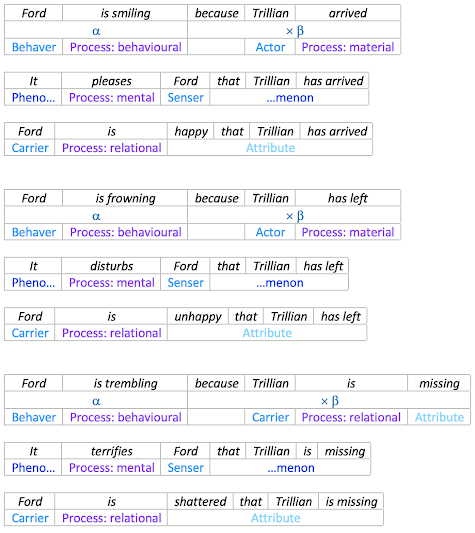
First, there is the question of semantic motifs running through the grammar which cannot be generalised at that level because of their diverse structural realisations.  The following proportionalities can be used to illustrate this point: 
Following Halliday (1985), the first clause in each set is behavioural, the second mental and the third relational — fundamentally different process types.  At the same time, all three clauses construct a relatively uniform, and not unfamiliar disposition for Ford.  One way to generalise across these various realisations of the same disposition is to stratify the content plane, setting up an attitude network realised across process types (with realisations extending into other areas of the grammar as well; for example, adverbial and nominal groups).

Blogger Comments:

To be clear, these 'semantic motifs' are the first of Martin's three reasons for his innovation of stratifying the content plane, despite the fact that the content plane is already stratified into semantics (meaning) and lexicogrammar (wording) in SFL Theory. Cf Halliday (1985: xvii-iii):
[1] To be clear, in SFL Theory, generalisation is a matter of systemic delicacy, not stratification. The relation between strata is one symbolic abstraction.

[2] To be clear, it is not true that different structural realisations necessarily warrant systems on a higher stratum. This is because the system of a stratum is already of a higher level of symbolic abstraction than the structures it specifies.

[3]  To be clear, the proportionality here is somewhat reduced, not least because, unknown to Martin, the first instance in each set is a clause complex, not a clause.

[4] To be clear, the "relatively uniform, and not unfamiliar disposition for Ford" in each set is variously construed as:
  • a behavioural Process manifesting a conscious state,
  • a mental Process impinged upon by a Phenomenon, and
  • an Attribute realised by a qualified Epithet.

The rhetorical device deployed here is unnecessary complication — in order to overload the reader. Martin could easily have just contrasted:
  • Ford is smiling [behavioural]
  • Ford is rejoicing [mental]
  • Ford is happy [relational]

[5] To be clear, having presented this as a reason for stratifying the content plane, Martin does not set up the proposed attitude network, and the issues are not raised again in the entire book.

Friday, 3 April 2015

Falsely Claiming That The Content Plane Was Not Stratified Before Martin (1992) [New]

Martin (1992: 15-6):
As we know, human languages elaborate these two strata in various ways: removing their experiential bias by adding foot and tone group ranks to the phonology, enabling the periodic and prosodic patterning characterising textual and interpersonal meaning; incorporating metafunctional layering in the grammar, of the different types discussed above; systematising combinations of words (groups) and reduced clauses (phrases) giving rise to an intermediate rank of group/phrase in the grammar (see Halliday 1985a:159); introducing morphology (eg. Hudson 1973), adding a rank below the word; providing for clause linkage (see Chapter 4) and so on. This raises the question of the point at which the grammar and phonology become saturated? When is stratification necessary within the content plane, especially given the extravagant approach to grammar pursued by systemic linguists as outlined above? Extravagant as systemic functional grammars are, they do run out of steam.


Blogger Comments:

[1]  This confuses language with metalanguage. To be clear, it wasn't human languages that elaborated these two strata in these specific ways but Halliday in his Systemic Functional theory of language.

[2]  This also confuses language with metalanguage. To be clear, any "experiential bias" is in theories of language that don't distinguish the different metafunctional modes of meaning.

[3] To be clear, the notion of a stratum becoming "saturated" or "running out of steam" is nonsensical, and derives from Martin's misunderstanding of the dimensions of SFL Theory as modules (pp 55, 77-8, 90, 268-9, 390, 488). The strata represent different views on language in terms of different levels of symbolic abstraction: 

  • the semantic stratum is language viewed as meaning,
  • the lexicogrammatical stratum is language viewed as wording
  • the phonological stratum is language viewed as sounding.

Accordingly, all wording is located on the lexicogrammatical stratum, no matter how "saturated" it gets, and, since it alone is concerned with all of wording, no other stratum can be of assistance if it "runs out of steam".

[4] This is very misleading indeed, because here Martin falsely claims that the content plane is not already stratified into semantics and lexicogrammar, and that he will be the one to do so. Importantly, Martin knows that the content plane is already stratified, because it is explicitly stated in the principal source of his ideas: Halliday & Hasan (1976: 5):

Moreover, the earlier notion of grammatical metaphor depends on the content plane being stratified into semantics and lexicogrammar, and Martin uses Halliday's semantic system of SPEECH FUNCTION, rebranding it as his NEGOTIATION.

If John Bateman's review of Martin's English Text is any guide, then Martin has been successful in this deception. See

Confusing Levels Of Symbolic Abstraction [New]

Martin (1992: 15):
The solution, referred to by Hjelmslev (1961) as the essential genius of human language, involves combining sounds in sequence to distinguish meanings. This immediately provides a stratified model with two ranks in the phonology, phoneme (distinct sounds) and syllable (distinct combinations of sounds) and one in grammar, the word (distinct meanings). At this point a second language can be proposed, lexese, in which there is a one to one relation between meanings and words.
As far as we know, evolved systems on the model of lexese do not occur. Once again, their limitations are obvious. They would require humans to remember an inordinately large number of words; and they have the further important limitation that no-one could mean something they hadn't already heard. The logical way out of systems of this kind is once more a combinatorial one — adding on a grammar than organises sequences of words. This brings us to something more closely resembling human language, at least as it is modelled in Hjelmslevian terms — a two strata system, with a minimum of two ranks on each stratum and an non-biunique (and therefore in principle arbitrary) relation between sound and meaning. This kind of two strata system is outlined in Fig. 1.11.


Blogger Comments:

[1] To be clear, Hjelmslev (1961) is concerned with expression and content; see [6] below.

[2] To be clear, the word, as grammatical form, is not meaning. The word realises meaning.

[3] This is a false conclusion to draw. To be clear, the one-to-one relation in this scenario is between wording and sounding, not between meaning and wording.

[4] To be clear, a language like lexese could not occur, because it requires grammatical form to emerge prior to the meaning it realises.

[5] To be clear, this does not resemble human language, because it is model in which words have no meanings.

[6] This is misleading, because it is not true. Hjelmslev's two levels are content and expression, whereas as Martin's are grammar and phonology. Where Hjelmslev's model includes meaning (in content), Martin's model does not.

On the one hand, this reflects Martin's misunderstanding of stratification, mistaking every stratum as a stratum of meaning; see later posts. On the other hand, it serves a rhetorical purpose, since Martin will later claim that he is filling a gap in SFL Theory by proposing a stratum of discourse semantics above the stratum of grammar, ignoring the fact that SFL Theory has always had a stratum of semantics above the stratum of grammar; see e.g. the primary source of Martin's model: Halliday & Hasan (1976: 5).

Misunderstanding Levels Of Symbolic Abstraction [New]

 Martin (1992: 14, 28n):

The strategy adopted here will be to review the arguments for distinguishing content and expression form, before pursuing the problem of stratifying the content plane.

To begin, consider a language called phonese, in which there is a one to one relation between sounds and meanings, such as that "spoken" by animals and young humans in the proto-language phase⁵ (Halliday 1975, Painter 1984). In such a language we have a very simple system of signs. Formulated systemically, it consists of a system with a list of features. The labelling of features in a system of this kind is a moot point; since content and expression are fused, either "semantic" or "phonetic" labels can be used.⁶ In Fig. 1.10 fused labels interfacing with both content and expression substance are employed; the language modelled there consists of six signs, with a bi-unique relation between meaning and sound.


⁵ Halliday, but not Painter, actually models the proto-language phase as a two strata system; Painter's mono-stratal characterisation is preferred here.

⁶ In traffic-light-ese this is the problem of labelling terms as [stop/speed up/go] or [red/yellow/green].


Blogger Comments:

[1] To be clear, on the model of Saussure, and its development by Hjelmslev (1961: 58), a sign necessarily entails two levels of symbolic abstraction: signifier/expression and signified/content. In SFL terms, the signifier/expression (Token) realises the signified/content (Value).

[2] This is misleading. Such a system involves a system of content features, together with realisation statements that specify the expression of each content choice.

[3] This is a very serious misunderstanding. Content and expression are not semiotically "fused", since they are different levels of abstraction. If only content features are used, then their means of expression are not specified; if only expression features are used, then the meanings they expressed are not specified.

[4] In Figure 1.10, content and expression features are mistakenly juxtaposed, as if they were of the same level of symbolic abstraction. The problem is easily rectified, and made consistent with SFL Theory, by placing the phonetic symbols in realisation statements; e.g. ➘ [ba] etc. But the problem here is not the absence of a symbol in a representation; it is Martin's failure to understand the most fundamental notion of semiotic systems: different levels of symbolic abstraction, and as will be seen, this pervades Martin's work.

Misrepresenting Agency As A Recursive System [New]

Martin (1992: 13, 12):
In addition to the experiential, interpersonal and textual metafunctions just considered, Halliday has in addition proposed a fourth metafunction, the logical. Systemically the logical metafunction comprises recursive systems (such as TENSE, PROJECTION and AGENCY in English; see Halliday 1985a), which tend to be associated across languages with experiential meaning. Structurally logical meaning is realised as another kind of particulate structure — but this time as part/part rather than part/whole. … These complementary perspectives are outlined in Fig. 1.9. 
 
The relationship between the metafunctions, realisation principles and types of structural [sic] is summarised in Table 1.3.


Blogger Comments:

[1] To be clear, in SFL Theory, recursive systems are realised by the iterative structures of the logical metafunction. Of the systems cited by Martin, the system of TENSE is realised by an iterative logical structure, and the system of PROJECTION is one system within the recursive systems of the clause complex and verbal group complex; see Halliday & Matthiessen (2014: 410, 438, 589). The system of AGENCY, on the other hand, is not a recursive system, and is not realised by an iterative structure; Halliday & Matthiessen (2014: 355):

The 'open-endedness' of ergative structure, whereby agency can be added in analytical causative constructions (Halliday & Matthiessen 2014: 352) is effected by the recursive system that is realised by the iterative structure of the verbal group complex. Halliday & Matthiessen 2014: 579-80):


[2] To be clear, this confuses formal constituency (nominal group consisting of words) with function structure (the relations between functional elements). In both experiential and logical structures of the nominal group, the structure is the relation between the functions of the constituents (parts). Halliday & Matthiessen (2014: 85) characterise the experiential as segmental, and the logical as iterative:

Misrepresenting Information Distribution [New]

 Martin (1992: 11-2):
Thirdly, constituency representation is also poorly adapted to textual meaning, which tends to structure clauses and groups in such a way as to highlight first and last position. The English clause for example uses first position to highlight the speaker's angle on the experience being constructed while last position is hearer oriented, highlighting information that is in some respect new. The systems of THEME and INFORMATION can thus be seen as assigning peaks of prominence to the beginning and end of the English clause; this textual patterning assigns a periodic texture to English discourse as it unfolds. Halliday's analysis of THEME and INFORMATION structure is presented in Fig. 1.7, followed by a more iconic form of representation highlighting clause texture as a rhythmic pulse.


Blogger Comments:

[1] As Halliday (1985: 169) explains:

The textual meaning of the clause is expressed by what is put first (the Theme); by what is phonologically prominent (and tends to be put last – the New, signalled by information focus); and by conjunctions and relatives which if present must occur in initial position. Thus it forms a wave-like pattern of periodicity that is set up by peaks of prominence and boundary markers.

Importantly, INFORMATION is not a system of the clause, and an information unit only coincides with the clause in the unmarked case. Moreover, in these unmarked cases, the New only occurs last in the unmarked case. The New can occur anywhere in the clause, or not at all (as is the case of the first clause in He said he didn't know).

As will be seen, Martin falsely assumes that New information always occurs in the Rheme of a clause, which is one of the factors that undermines his model.

[2] To be clear, the term 'texture' has a specific meaning in SFL Theory: the property of being a text, which is derived 'from the fact that it functions as a unity with respect to its environment' (Halliday & Hasan 1976: 2).

Preparing To Argue 'From Below' And Misunderstanding 'Cumulative' [New]

Martin (1992: 10, 28n):
Structural arguments for metafunctional diversity are of particular relevance here in light of the proposals for discourse structures to be developed in Section 1.5 below. Halliday's (1979a) suggestion is that experiential meanings predispose particulate forms of realisation, interpersonal meanings prosodic ones and textual meanings periodic² ones.

² Halliday (1979) actually refers to periodic structures as culminative ones; the term periodic is preferred here because of the misleading association between culmination and final position.


Blogger Comments:

[1] To be clear, arguing for metafunctional diversity on the basis of structure is arguing 'from below', which is the direct opposite of the perspective taken in SFL Theory, where priority is given to the view 'from above'. Halliday & Matthiessen (2014: 49):

Giving priority to the view ‘from above’ means that the organising principle adopted is that of system: the grammar is seen as a network of interrelated meaningful choices. In other words, the dominant axis is the paradigmatic one: the fundamental components of the grammar are sets of mutually defining contrastive features. Explaining something consists not in stating how it is structured but in showing how it is related to other things: its pattern of systemic relationships, or agnateness …

[2] To be clear, in the field of linguistics, the term 'culminative' is not associated with final position, but with prominence, which in SFL Theory, is a resource of the textual metafunction. The notion of 'culminative function' is from the phonology of Trubetskoy (1960):

the function carried out by those characteristics (features) of sounds in speech that permit the listener to apprehend the number of words, or syntagmas, in a sentence. The unit containing the element of sound that performs the culminative function is called the culmination, for example, the culmination of a syntagma. The culminative function in German, for example, is performed by the primary stress. Stress, pitch, and other prosodic elements usually carry out the culminative function.

Blurring The Distinction Between Function (Structure) And Form (Rank Scale) [New]

Martin (1992: 5-6):

Fig. 1.2 represents the clause as a bundle of features, realised by the structural sequence Finite^Subject^Predicator.
Note that structures of this kind contain both function (e.g. Finite; initial upper case) and class labels (e.g. clause; lower case, enclosed in square brackets). These structures, like the systems which underlie them, are further organised along a scale of rank, which reduces the number of levels between clause and morpheme required in analysis (see Hudson 1967/1981). Making use of a different set of functions (from Halliday 1985a), implying a different set of options, this labelling and bracketing is further illustrated in Fig. 1.3. Three ranks are included (i.e. clause, group and word), but word structure is not shown.


Blogger Comments:

[1] This is potentially misleading. In SFL Theory structures are relations between functions. The string of formal units of various classes is known as a syntagm.

[2] This is also potentially misleading. The rank scale is a way of modelling formal constituency, such that a clause consists of groups and phrases, which consist of words, which consist of morphemes. Functions are assigned to constituents of a unit, such as groups and phrases of a clause, and it is the relations between these functions that constitute the structure of the (higher ranked) unit.

[3] See Halliday (1985: 22-30) on ranked constituent analysis (minimal bracketing, function labelling) vs immediate constituent analysis (maximal bracketing, class labelling).

Misconstruing Realisation And Instantiation [Augmented]

Martin (1992: 5):
As noted above, system is related to process through the concept of realisation — realisation formalises the instantiation of the system in process. … These realisation statements relate system to structure; the statements in Fig. 1.1 are summarised and then glossed to clarify their reading in Table 1.1.


Blogger Comments:

[1] System is related to structure through the concept of realisation — not to the process of instantiation.

[2] Realisation doesn't "formalise" the instantiation of the system in process.  Realisation is an intensive identifying relation (token-value) between levels of symbolic abstraction, as between strata and between axes; instantiation is an intensive attributive relation (token-type) between actual instances of the system and the overall system of potential (Halliday & Matthiessen 1999: 14-5, 145).  See also here.