Martin (1992: 33-4):
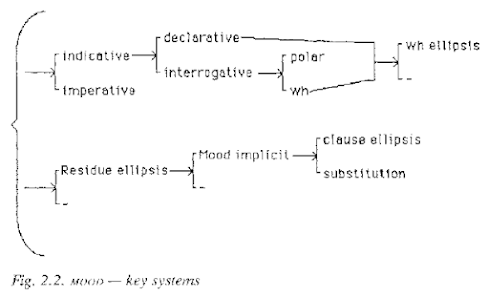
Furthermore, as can be seen from the examples above, the relevance of the co-text is also grammaticalised in English. The relevant systems have to do with clause ellipsis and substitution and are described in detail in Halliday and Hasan (1976). There are two major patterns to be considered. The first can be established with respect to the more general MOOD functions Mood (including Subject, Finite and Mood Adjuncts) and Residue (including Predicator, Complement and other Adjuncts) and illustrated as follows:
Get me the new one, please. — Allright, I'll get it for you.
Get me the new one, please. — Allright, I will Residue.
Get me the new one, please. — Allright Mood Residue.
The first response (Allright, I'll get it for you.) is full, though potentially elliptical. The second (Allright, I will.) ellipses the Residue. The third (Allright.) ellipses both Residue and Mood functions. Alternatively, the Mood and Residue functions together may be substituted with so or not.
Will he make it? — Maybe so.
Will she win it? — Perhaps not.
The second pattern is found in the environment of wh interrogatives of both the first order and second order (echo) types; again, both elliptical and potentially elliptical structures are found:
Which is the new one? — This one's the new one.
Which is the new one? — This one.
This is the new one. — Which one's the new one?
This is the new one. — Which one?
As before, there is no one to one relation between grammatical class and discourse function. Responses may be either elliptical or not, as illustrated. In addition, elliptical clauses may initiate dialogue, with ellipsed information typically recoverable from the non-verbal context:
//2 Coming? // — Yes, I am.
//1 Leaving now. // — Oh, are you?
Blogger Comments:
[1] To be clear, this is nonsensical. The "relevance of the co-text" cannot be "grammaticalised". Grammaticalisation is essentially a move from the lexical end of lexicogrammar to the grammatical end, as when 'content words' become 'function' words.
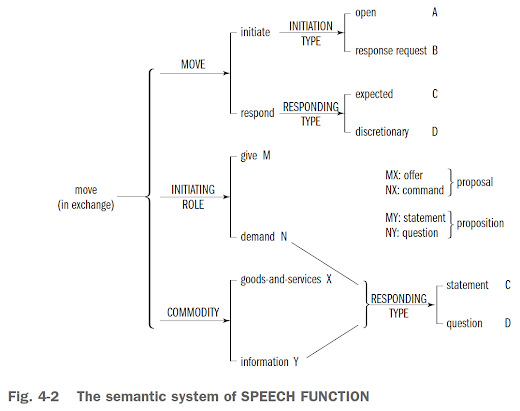
[2] To be clear, Martin is here arguing that there is no 'one to one relation' between interpersonal semantics and interpersonal lexicogrammar. This would require demonstrating that there is no 'one to one relation' between the selection of SPEECH FUNCTION features and their realisation in the selection of MOOD features. However, instead, Martin presents only textual systems of the grammar, ellipsis-&-substitution, and does so without regard to the semantic systems they realise.
Moreover, Martin cannot relate ellipsis-&-substitution to his interpersonal semantics because he subsumes ellipsis-&-substitution within his textual system of IDENTIFICATION (p100-1), his rebranding of Halliday & Hasan's cohesive reference.
[3] Again, Martin misunderstands grammatical functions — here: ellipsis-&-substitution — as grammatical classes (forms).