Showing posts with label projection. Show all posts

Friday, 25 December 2015

Misrepresenting Interstratal Realisation, Grammatical Metaphor & Register

Martin (1992: 389-90):
The relationship of SPEECH FUNCTION to MOOD mediated by interpersonal metaphor is precisely parallel to that between CONJUNCTION and the clause complex as mediated by ideational metaphor.  Because of this it was possible to present a register neutral description of the semantics of dialogue in Chapter 2, just as it was possible to produce a register neutral description of conjunctive relations in Chapter 4.  Both these types of organic relation are essential components of English text forming resources and need to be interpreted systematically as semantic systems in language, not as register specific features of context.

Blogger Comments:


[1] This is untrue.  Speech function and mood are both interpersonal systems — at the level of semantics and lexicogrammar respectively — and the relationship between them is realisation (congruent or metaphorical).  However, whereas clause complexing is a manifestation of the logical metafunction in lexicogrammar, Martin's discourse semantic system of conjunction takes as its point of departure the textual system of cohesive conjunction.  Because this cohesive system is the textual deployment of expansion relations, the other major logico-semantic type, projection, is absent from the discourse semantic model.  This is a major theoretical shortcoming, since clause complexes involving projection are not accounted for semantically.  Crucially, this in turn removes the means of distinguishing congruent vs metaphorical realisations in the grammar.

[2] The realisation relation between strata is not "mediated" by grammatical metaphor.  Realisations are either congruent or metaphorical, the latter being a manifestation of the textual metafunction as a second-order resource (Halliday & Matthiessen 1999: 398-9).

[3] The realisation relation between strata applies to all systems on all strata.  It does not provide a special means of presenting "register neutral" descriptions for two of the four discourse semantic systems.

[4] In SFL theory, the relation between the general system of semantic potential and the semantic systems of specific registers is theorised as instantiation.  The interpersonal semantic systems of specific registers are termed exchange relationships.  Halliday & Matthiessen (1999: 377-8): 
Midway between potential and instance, sets of such strategies cluster within ranges of tenor values. Such a cluster is the interpersonal analogue of a domain in the ideation base: it is a region within the overall interpersonal space of meaning, selected according to tenor, just as a domain is a region within the overall ideational space of meaning, selected according to field. The options in interpersonal meaning that make up the cluster together enact a tenor relationship … We might call such a cluster an exchange relationship to foreground that it is semantic (i.e. constituted in meaning through exchanges of meaning) and that it is interpersonal (rather than one-sidedly personal). To indicate that it is analogous to a domain model, we might have called it an exchange or interaction “model”; but we have avoided that term because it suggests a construal of something and construal is the ideational mode of meaning — it is more like a protocol than a model.
[5] To be clear, the term 'organic relation' is used by Hasan (1985: 81) with respect to the textual metafunction: to differentiate conjunction from the other ('componential') types of cohesion:
These devices are ORGANIC; the terms in the tie are whole message(s) rather than message components…
[6] In SFL theory, the text forming resources are the systems of the textual metafunction.  In discourse semantics, the systems of all metafunctions are said to be text forming.

[7] To be clear, in SFL theory, 'register specific features of context' are the features of specific situation types (field, tenor and mode) that are realised by specific registers of language.  This is not what Martin means.  See the critiques of field in Chapter 5.

Sunday, 25 October 2015

Misconstruing Projection As Enhancement

Martin (1992: 317):
The same prepositional phrases used to enhance Processes can also be used to enhance Things, functioning as Qualifiers in nominal groups:
CIRCUMSTANTIAL QUALIFIERS
the restaurant at the end of the universe
the race through the galaxy
the noise from the engine room
the ship like Ford's
the present for Zaphod
the story about Trillian

 Blogger Comment:

The relation between the Thing and Qualifier is projection: matter, not enhancing expansion.

Thursday, 22 October 2015

Reducing All Verbal Group Complex Relations To Extension

Martin (1992: 315-6):
With verbal groups, extension combines events.  Halliday (1985: 255-69) categorises a wide variety of verbal group complexes with respect to both expansion and projection.  He reserves the category of extension for conation… 
For purposes of lexical cohesion analysis however, all verbal group complexes will be treated as involving extension here, in order to bring out proportionalities of the following kind:
 ELABORATION : EXTENSION : ENHANCEMENT ::
(phrasal verb : verbal group complex : event x quality ::)
look into : keep looking : look carefully ::
run into : attempt to run : run quickly ::
see through : happen to see : see clearly ::
go over : promise to go : go reluctantly
etc.

Blogger Comments:

[1] Extension — in common with projection, elaboration and enhancement — relates verbal groups logically in a verbal group complex.

[2] The logical grammatical structure of verbal group complexes is not a factor in analysing cohesive (textual nonstructural) relations between lexical items.

[3] To treat all verbal group complexes as involving extension — for whatever reason — is to miscategorise the instances that do not involve extension, and to misrepresent the category 'extension'.  Three of the four examples do not involve extension, and one does not even involve expansion:
  • keep looking is elaboration: phase: time: durative
  • happen to see is enhancement: modulation: cause: reason
  • promise to go is projection: proposal: locution

[4] Any proportionalities that depend on a falsehood are themselves false.  Moreover, no argument is provided for the value of cross-categorising types of expansion with phrasal verbs, verbal group complexes, and clause fragments.

[5] As related by enhancement, these examples are each Process and Manner circumstance within a clause realising a figure.


General Observations:
  • The concern here is purported to be discourse semantics, but the focus is merely on (rebranding) the grammar.
  • The concern here is purported to be the experiential metafunction, but the focus is on (rebranding) logical relations.

Sunday, 11 October 2015

Misconstruing Logico-Semantic Relations Realised In The Clause [2]

Martin (1992: 311):
Table 5.7 illustrates a number of these Process ° Range constructions.  Note the way in which they contrast with the Process ° Medium structures in parentheses.  From the point of view of field, the Process ° Range:process structure involves just one meaning (which is realised through two lexical items, one elaborating the other; the Process ° Medium structures on the other hand involve two meanings, and an action and the participant that action is mediated through).


Table 5.7. Elaboration and extension in the clause
Clause
process
=
range:process
(process + medium)
play

tennis
(play + the ball)
sing

song
(sing + her x to sleep)
score

run
(score + some dope)
ask

question
(ask + Mary x to tea)
tell

story
(tell + him off)
take

bath
(bathe + the baby)
do

dance
(dance + her x over)
make

friend
(befriend + John)


Blogger Comments:

[1] The view from field is irrelevant to whether or not 'the Process ° Range:process structure involves just one meaning'.

[2] A 'Process ° Range:process structure' construes two meanings: a process and a range of the process — not one.

[3] In the case of a verbal Process, the Range (Verbiage) is related to the Nucleus by projection, not elaborating expansion.

[4] In SFL theory, logico-semantic relations obtain between the Nucleus and participants (and circumstances) outside the Nucleus — not between the Process and Medium within the Nucleus. There are no extending relations between the Nucleus and other participants (Halliday & Matthiessen 1999: 174-5).

[5] 'Friend' is an entity, not a process.

[6] In such construals, 'Mary' functions as Beneficiary (Receiver), not Medium — the omitted Sayer is the Medium.  The Receiver is related to the Nucleus by enhancement, not extension.

Saturday, 10 October 2015

Misconstruing Logico-Semantic Relations Realised In The Clause [1]

Martin (1992: 309-10, 311):
The basic strategy used here will be to apply Halliday's general logico-semantic relations of expansion to clause, nominal group and verbal group meanings in order to produce a more abstract level of interpretation. … With clauses, elaboration is through Process ° Range: process (as opposed to Range: entity) structures.  These are of two kinds.  One type makes use of a general verb such as do, make, take etc. and expresses the experiential meaning of the process as a Range: e.g. do work.  The Range in effect elaborates on the general verb by specifying the meaning involved.  The other type makes use of a more specific verb which the Range function then subclassifies; the verbs play and tell are commonly specified in this way.  From the point of view of field, playing tennis, playing monopoly, playing rummy and so on are all hyponyms of play.  As Halliday (1985: 135) points out, "Tennis is clearly not an entity; there is no such thing as tennis other than the act of playing it."
play = tennis/football/cards/monopoly/chess/rummy…
tell = joke/story/anecdote/news/answer/solution… 


Blogger Comments:

[1] In SFL theory, the logico-semantic relations of both expansion and projection obtain in the figure between the Nucleus (Process/Medium) and other participants (and circumstances) — see Halliday & Matthiessen (1999: 174-5).  That is, the relation is not between the Process and participants, and the type of relation is not restricted to expansion.

Elaboration in the figure is not restricted to Range: process.  It is also the relation between the Nucleus and Range as Attribute: quality and as Attribute: class.

[2] This describes only Range in material clauses, namely Scope.  Range occurs with all process types except the existential (Halliday & Matthiessen 2004: 293).  It corresponds to Behaviour in behavioural clauses, Verbiage in verbal clauses, Attribute in attributive clauses, Value in decoding identifying clauses, and Phenomenon in emanating mental clauses.

[3] The Range: process elaborates the Nucleus, not the verb.

[4] When the verb tell serves as a verbal Process, the logico-semantic relation between the Nucleus and the Range (Verbiage) is projection, not expansion: elaboration.

[5] More accurately, semantically, tennis, monopoly, rummy and so on are all hyponyms of game.  The Halliday quote on Range is irrelevant to the hyponymy analysis.

Sunday, 16 August 2015

The Omission Of Projection And Hypotactic Elaboration From The Logic Of Discourse Semantics

Martin (1992: 235):
The Hartford school modelled conjunctive relations between actions, more or less equivalent to the TRANSITIVITY function Process in systemic theory.  Since TRANSITIVITY relations are treated as part of lexicogrammar in the model developed here, an appropriate discourse semantics unit needs to be found.  The unit message will be adopted here, where this is realised as a ranking clause that is neither a projection, nor a hypotactically dependent elaborating clause.  This means that locutions and ideas, elaborating beta clauses and all embedded clauses will be treated as part of messages rather than as conjunctively related units in their own right.

Blogger Comments:

[1] In SFL theory, transitivity is a system of the experiential metafunction.  A consistent discourse semantics unit with 'transitivity relations' would therefore be an experiential unit.  Here, however, it is a logical discourse semantics unit that is deemed 'appropriate'.  In the grammar, it is the rank units (forms) that are logically related in complexes.

[2] In SFL theory, the term 'message' is already used for a unit of the textual metafunction on the semantic stratum, and it is (groups of) messages that are conjoined by cohesive conjunction.  Here it is used for units related by conjunction, but, as conjunction is misconstrued as logical and structural, it is misconstrued as a unit of logical structure.  That is, although textual meaning has been misconstrued here as logical, the textual term has been retained, thereby creating a further theoretical inconsistency — cf 'clause as message', the thematic (textual) structure of the clause.

[3] In SFL theory, there are two major types of logical relations: expansion and projection.  The second of these major types, projection, is thus not included as a logical relation at the level of discourse semantics.

Similarly, within expansion, there are three major types: elaboration, extension and enhancement.  The first of these major types, elaboration, is thus not included as a logical relation at the level of discourse semantics — if the interdependency relation is hypotactic.

Excluding both major logical relations has serious ramifications for considerations of the distinction between congruent and incongruent stratal relations in determining grammatical metaphor.

The absence of projection follows from the rebranding of cohesive conjunction, which is the deployment of (only) expansion relations by the textual metafunction at the stratum of lexicogrammar, as the logical dimension of a higher stratum: discourse semantics.

On the other hand, in the discourse semantic model, types of elaboration are variously misconstrued as types of extension or enhancement, as demonstrated in earlier posts.

Saturday, 25 April 2015

Dependent Clauses, Speech Function And Negotiability [New]

Martin (1992: 41-2):
Hypotactically dependent clauses may turn out to be better taken from a discourse perspective as an intermediate case (between embedded and independent clauses) — quantative [sic] studies might well show them to be more negotiable than embedded clauses, though less likely to be responded to than independent ones. Note in this connection that when projection is used to express modality metaphorically (Halliday 1985a:336), it is the structurally dependent clause that is in fact being negotiated:
I think he'll be there. (meaning 'maybe he'll be there'.)
— Will he? (more likely than Oh, do you?)
This need not of course block the 'sardonic' interlocutor from negotiating the projecting clause as if it deserved a congruent reading:
"I'm inclined to think—" said I.
"I should do so," Sherlock Holmes remarked impatiently.
I believe that I am one of the most long-suffering of mortals; but I'll admit that I was annoyed at the sardonic interruption. "Really, Holmes," said I severely, "you are a lit[t]le trying at times." (Doyle 1981:769)
Pending quantitative investigation of these patterns, hypotactically dependent clauses will be grouped with embedded ones as in the network above. The most negotiable clause type in this category involves dependent elaboration as these clauses can be tagged:
α Sherlock put Watson down,
= β which was mean, wasn't it?


Blogger Comments:

[1] As previously observed, Martin is here trying to determine the grammatical unit that realises speech function, but is instead concerned with arguability ("negotiability"), which is a separate issue from speech function. Embedded and some dependent clauses may be presented as unarguable, but that does not necessarily entail that they do not realise a statement, question, command or offer. For example, in this hypotactic complex:

I asked if you like Joy Division

the dominant clause realises a statement, while the dependent clause realises question, as demonstrated by its paratactic agnate:

I asked "do you like Joy Division?"

[2] To be clear, thirty years on, these quantitative investigations remain undone.

[3] To be clear, this needs to be accounted for in the model, not just mentioned and forgotten.

[4] Strictly speaking, despite the relative pronoun which, the expansion relation in this instance is extension, rather than elaboration, since

  • the dependent clause adds to the meaning of the dominant clause, rather than describes it;
  • the paratactic agnate of the dependent clause is and that was mean, wasn't it?;
  • it does not involve tone concord, since the unmarked tones would be tone3 and tone1.

Halliday & Matthiessen (2014: 468):

There is one group of non-defining relative clauses that strictly speaking would belong with extension rather than elaboration; for example,
||| She told it to the baker’s wife, || who told it to the cook. |||
Here the who stands for ‘and she’ and the clause is semantically an additive: the agnate paratactic variant would be ... and she told it to the cook. …

Note that such instances are not characterised by tone concord.

Martin's MOOD Network For Clauses Realising SPEECH FUNCTION [New]

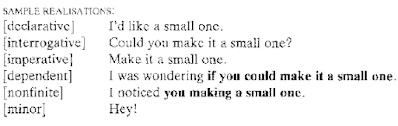
Martin (1992: 40-1, 91n):
The MOOD network underlying this definition is presented below, along with examples of realisations for terminal features. [Ventola's 1988a criticisms of the unit proposed will be taken up in 2.3 below.] 

² The I/T superscript notation shows that dependent/embedded clauses are declarative by default; according to this network projected proposals have both nonfinite (I asked him to come) and dependent (I asked him if he could come) realisations.


Blogger Comments:

[1] To be clear, this MOOD network falsely proposes that all dependent and embedded clause are finite. This is falsified by Martin's own example I noticed you making a small one which features a nonfinite embedded clause. Halliday & Matthiessen (2014: 171):
Whether they are dependent or downranked, ‘bound’ clauses may be either ‘finite’ or ‘non-finite’.
As Halliday & Matthiessen (2014: 23-4) explain:
A major clause is either indicative or imperative in MOOD; if indicative, it has a Finite (operator) and a Subject. An indicative clause is either declarative or interrogative (still in MOOD); if declarative, the Subject comes before the Finite. An interrogative clause is either yes/no type or WH-type; if yes/no type, the Finite comes before the Subject; if WH-type, it has a Wh element.

[2] To be clear, Martin is concerned here with determining the grammatical unit that realises a proposition or proposal, despite the fact that Halliday had already identified the unit as the clause in its interpersonal guise. Martin has determined that only clauses "selecting independently for mood" realise these major speech functions, but falsely claims that this excludes dependent and embedded clauses; see previous post.

Essentially, Martin here confuses speech function with arguability. Dependent and embedded clauses can realise propositions and proposals; it's just that, in such forms, they are presented as less arguable than propositions and proposals realised by ranking independent clauses.

[3] This is misleading, because it is untrue. To be clear, this network says nothing whatsoever about projected proposals. Moreover, non-finite vs dependent is a false dichotomy: both projected clauses are dependent, the first being non-finite, the second finite. Note also that the non-finite projected clause is simply to go, because, in both projection nexuses, him serves as the Receiver of the projecting clause I asked him.

Sunday, 19 April 2015

Martin's Logical Discourse Semantic System Of CONJUNCTION [New]

Martin (1992: 27):
CONJUNCTION focuses on logical meaning — on relations of addition, time, cause and comparison between messages, as these are variously realised through paratactic, hypotactic and cohesive conjunctions (or metaphorically within a clause; see Chapter 4 for details). Once again, this analysis is inspired by Gleason (1968) and by Halliday and Hasan (1976).


Blogger Comments:

To be clear, Martin's logical discourse semantic system of CONJUNCTION is far more than just "inspired" by Halliday & Hasan (1976). It is a confusion of Halliday & Hasan's cohesive CONJUNCTION and Halliday's CLAUSE COMPLEXING, misunderstood and relocated from lexicogrammar to Martin's discourse semantics. That is, Martin confuses expansion features serving the textual metafunction (cohesive CONJUNCTION) with expansion features serving the logical metafunction (CLAUSE COMPLEXING). This confusion is maintained by Martin's use of Halliday's textual unit 'message' as his logical unit (p325).

The reason why Martin uses the relations of addition, time, cause and comparison instead of expansion and its most general subtypes elaboration, extension and enhancement is that these were the categories used in Martin's source, Halliday & Hasan (1976).

Moreover, because the logico-semantic relation of projection does not function cohesively, Martin's model of logical semantics omits the system of PROJECTION. That is, there is no semantic system to be realised lexicogrammatically by projection relations between units in unit complexes or metaphorically, for example, in circumstantial relational clauses such as the lecture covered topics in evolutionary biology.