Showing posts with label chapter 2: negotiation. Show all posts

Thursday, 6 October 2016

Post Titles For Chapter 2 — Negotiation: Shaping Meaning Through Dialogue

The titles of the posts that evaluate chapter 2 provide a glimpse of some of its theoretical shortcomings.
  1. Negotiation As The Semantics Of Mood
  2. Misrepresenting Halliday On Mood And Misunderstanding Ineffability And Stratification
  3. Misrepresenting Stratification
  4. Misrepresenting Stratal Relations
  5. Confusing Context With Co-Text And Material Setting
  6. Using A Textual Grammatical System To Argue For An Interpersonal Semantic System
  7. Strategically Misrepresenting The Relation Between Speech Function And Mood
  8. Serious Problems With Martin's Mood System
  9. Misrepresenting The Realisation Of Speech Function In Mood
  10. Trying To Classify Speech Function 'From Below'
  11. Misrepresenting Hasan's Work On Speech Function
  12. Using Modality To "Determine" Speech Function
  13. Misunderstanding Modality In Responses To WH- Interrogatives
  14. Blurring Context And Material Setting 
  15. Confusing Semogenesis And Stratification 
  16. Misrepresenting Speech Function And Mood
  17. Martin's MOOD Network For Clauses Realising SPEECH FUNCTION
  18. Misrepresenting The Interpersonal Function Of Independent, Dependent And Embedded Clauses
  19. Dependent Clauses, Speech Function And Negotiability
  20. Misrepresenting Nonfinite Clauses
  21. Greetings and Calls
  22. The Line Between Exclamations and Statements
  23. Misrepresenting The Potential Of Ellipsis To Negotiate Attitude
  24. Misrepresenting Stratification
  25. Misrepresenting Speech Function
  26. Misunderstanding Stratification And Incongruence
  27. Underestimating The Mood Grammar
  28. The Inconsistency In Treating Genre As A Connotative Semiotic
  29. Confusing Paradigmatic Features With Syntagmatic Structure
  30. Misconstruing Metafunctions As Modules
  31. Misconstruing Stratification 
  32. Misrepresenting Structure, Metafunction And Stratum 
  33. Confusing Unmarkedness And Congruence 
  34. Martin's Reason Why Discourse Semantic Units Cannot Be Defined As Categorically As Grammatical Units
  35. Conflating Content And Expression
  36. Martin On Modularity, Realisation And Reddy's Conduit Metaphor
  37. Misunderstanding Stratification
  38. Martin's Problems With Explicitness

Friday, 1 May 2015

Martin's Problems With Explicitness [New]

Martin (1992: 90):
In this Chapter a general framework for analysing conversational structure has been proposed. Its focus was on the discourse semantics of MOOD, and so the discussion was restricted in several places to interpersonal meaning, setting aside as far as possible the logical, textual and experiential metafunctions. This is in accordance with the modular strategy to building up a picture of discourse semantics adopted in English Text.
As is apparent, modularity poses problems of explicitness even within the interpersonal perspective adopted throughout Chapter 2. Investigating the complex interrelationships between the systems of TONE, MOOD, SPEECH FUNCTION and NEGOTIATION is a major task which has barely been broached here. …


Blogger Comments:

[1] This again repeats Martin's misunderstanding of SFL Theory as 'modular' in its view of language, with the metafunctions and strata misconstrued as modules.

[2] This is potentially misleading, since it invites the reader to believe that a metafunctional approach to semantics is Martin's innovation, rather than the innovation of Halliday in formulating SFL Theory.

[3] This is misleading, because it is the direct opposite of what is true. On the one hand, the theoretical dimensions of metafunction and stratification provide the means of being very explicit within the theoretical architecture that they precisely specify. 

On the other hand, the "complex interrelationships" between the systems of TONE, MOOD, and SPEECH FUNCTION — and so NEGOTIATION — have already been "investigated" by Halliday. For example, the relation between MOOD, and SPEECH FUNCTION has been described in terms of congruent and metaphorical grammatical realisations of the semantic system features, and the relation between TONE and MOOD has been described in terms of the system of KEY. See, for example, Halliday (1985: 68-71, 342-5, 284-5).

Misunderstanding Stratification [New]

Martin (1992: 81):

As noted above, in general English Text prefers to distribute descriptive responsibility for text structure across phonology, lexicogrammar and the four different systems comprising the discourse semantics.


Blogger Comments:

This misunderstands stratification. To be clear, in SFL Theory, the text is a semantic unit, and text structure is thus the syntagmatic dimension of the semantic stratum. Lexicogrammar and phonology provide descriptions of lexicogrammatical and phonological structures, not text structure. The lexicogrammatical systems of cohesion do provide descriptions of realisations of textual cohesion, but not text structure.

Martin's four discourse semantic systems, on the other hand, are his rebrandings of Halliday & Hasan's (1976) systems of lexicogrammatical cohesion and developments of Halliday's semantic system of speech function.

Martin On Modularity, Realisation And Reddy's Conduit Metaphor [New]

Martin (1992: 77-8):
There is no reason in principle why these macro- and micro-perspectives should not complement each other and in time converge. For this synthesis to occur however it would be necessary for conversational analysts to make more explicit their position on a number of key issues:
a. MODULARITY — how many components will the model of conversation have?; and what role will language play in this modularity?

b. REALISATION — how are these different components related (by rank, strata, plane, metafunction etc.)?

c. TYPE OF STRUCTURE — what kinds of structure are adjacency pairs: univariate, multivariate or other?; is constituency or dependency representation appropriate?

d. ROLE OF GRAMMAR — will this be viewed as a meaning making module?; or will it be preferred to invoke the conduit metaphor (Reddy 1979)?


Blogger Comments:

To be clear, here Martin is viewing the work of conversational analysts in terms of the architecture proposed by SFL Theory.

[1] This again repeats Martin's misunderstanding of SFL Theory as 'modular' in its view of language. Importantly, metafunction and stratification are global dimensions of the theory (Halliday & Matthiessen 2014: 20, 32). Each are complementary perspectives on the same phenomenon. As different perspectives on the same phenomenon, they cannot "interact".

[2] This misunderstands realisation. To be clear, realisation is the (elaborating identifying) relation between different levels of symbolic abstraction, as between system and structure, between strata and between planes. 

The rank scale, on the other hand, is all of the same level of symbolic abstraction, grammatical form, and its organising principle, composition, is a type of extension, not elaboration.

Similarly, the metafunctions are not related as different levels of symbolic abstraction, but are different types of function that are distributed throughout the content plane.

[3] This again reflects Martin's confusion of semogenesis (meaning making) with stratification (grammar realising meaning).

[4] This is a false dichotomy, since the conduit metaphor is simply a view of grammatical forms as containers of meaning.

Conflating Content And Expression

Martin (1992: 76):
[The discussion] has dealt only minimally with intonation; whether this is treated as a meaning making resource in its own right following El-Menoufy (1988), as most delicate MOOD following Halliday (1967c), or as a direct coding of discourse structure following Brazil (1981), this omission is a serious one.

Blogger Comments:

[1] This again confuses semogenesis ('meaning making resource') with stratification ([realising] 'most delicate mood', 'coding of discourse structure').

[2] Halliday does not treat intonation as most delicate mood.  Intonation is a system in the rank scale of the phonological stratum (expression plane), whereas mood is a system of the lexicogrammatical stratum (content plane).

The interpersonal intonational system of tone realises the interpersonal lexicogrammatical system of key (more delicate mood), while the other intonational systems, tonicity and tonality, are resources of the textual metafunction.

Halliday & Matthiessen (2004: 142):
The tones are not, however, simply additional markers attached to the realisation of mood. They realise distinct grammatical systems of their own, which are associated with the mood categories. The general name for systems that are realised by tone is key.

Thursday, 30 April 2015

Martin's Reason Why Discourse Semantic Units Cannot Be Defined "As Categorically As" Grammatical Units [New]

Martin (1992: 59):
A2 Can you get me a beer in light of my impending death from thirst? …
The point is that seen as process, any dialogue is an on-going site of textual dynamism. There is nothing to prevent an interlocutor digging in and negotiating information presented as non-negotiable: my impending death from thirst is not presented for grading in the first example above; but one can imagine contexts in which it is contested, light-heartedly or not.

Because of this dynamism it is not possible to define discourse units as categorically as grammatical ones. There is a system, but its potential for ongoing re-contextualisation means that there will always be rough edges for the analyst. Analysis in other words will inevitably involve interpretation.


Blogger Comments:

To be clear, this is a non-sequitur. The ability to negotiate wording that lies in the Residue of a clause (in this instance: my impending death from thirst) can have no bearing on what constitutes a unit at a higher level of symbolic abstraction. If such a wording is taken up for negotiation, it simply falls within the Mood or Residue of the following clause. In SFL Theory, the semantic unit that such clause realises is a move (proposition or proposal) in an exchange (Halliday 1985: 69-71).

Confusing Unmarkedness And Congruence

Martin (1992: 58-9):
Halliday's (1985) notion of congruence bears on the problems encountered here.  Just as one can argue that there is an unmarked relationship between grammar and phonology whereby tone groups are associated with a single clause, so one might suggest that a similar unmarked relationship holds between a move and a clause complex: generally speaking a move in the exchange will be realised by a clause and its dependents.

Blogger Comment:

This is not congruence.  In SFL theory, congruence refers to a non-metaphorical relation of meaning (semantics) to wording (lexicogrammar).

On the other hand, the unmarked option is 'the form we tend to use if there is no prior context leading up to it, and no positive reason for choosing anything else' (Halliday & Matthiessen 2004: 58), in contradistinction to marked, which means that the option is less frequent and 'carries a special interpretation' (Halliday & Matthiessen 2004: 207).

The realisation of a single clause as a single tone group is unmarked tonality — where tonality refers to the selection of the number and boundaries of tone groups (Halliday 1970).

Wednesday, 29 April 2015

Misrepresenting Structure, Metafunction And Stratum

Martin (1992: 56):
In a model of discourse structure such as that proposed by the Birmingham school, all aspects of text structure have to be incorporated into a single rank scale such as act-move-exchange-transaction-lesson.  This naturally puts a great deal of pressure on move structure to capture cohesive relations as multivariately structured act sequences.  Here on the other hand, identification, conjunction and ideation will be treated separately from negotiation as discourse structures in their own right.

Blogger Comments:

Cohesive relations cannot be "captured" by move structure as multivariately structured act sequences — whatever the pressure — for three reasons.
  • First, cohesive relations are not structures, multivariate or otherwise.
  • Second, cohesive relations are textual in metafunction, whereas act sequences are presented as interpersonal.
  • Third, cohesive relations are lexicogrammatical in terms of level of symbolic abstraction, whereas act sequences are presented as semantic.

Misconstruing Stratification

Martin (1992: 55, 56):
Where grammar is conceived as making meaning, there is no need to add an extra layer of interpretation to the semantics to simply re-label these functions. …
The general point here is that if the grammar, or the phonology for that matter, does the work, so be it.  The model developed here does not dualise meaning and form and so does not have to re-state the contributions made by phonology and lexicogrammar to text structure at the level of semantics.

Blogger Comments:

[1] This confuses semogenesis with stratification.  The grammar making meaning is semogenesis.  In terms of stratification, the grammar realises meaning; grammar (wording) is construed as a lower level of symbolic abstraction than semantics (meaning).

[2] In proposing a level of symbolic abstraction above the grammar, it is necessary to make explicit both the system of choices at the level of semantics (meaning), and how they are congruently realised at the level of lexicogrammar (wording).  The reason it is necessary is because it is this that provides the baseline for examining incongruent realisations — grammatical metaphor — the major means of expanding meaning potential.

[3] SFL theory contrasts meaning with wording, as in the content plane strata, semantics and lexicogrammar, and form with function, as in the grammatical rank scale, where functions at a higher rank are realised by forms at the rank below.

Tuesday, 28 April 2015

Misconstruing Metafunctions As Modules [New]

Martin (1992: 55, 56):

For various reasons this multivariate approach to move structure will not be pursued here. These reflect in general the modular approach to text structure underlying English Text, …

Equally important, as far as modularity is concerned, is the fact that negotiation provides just one of four perspectives on text structure elaborated in the model of discourse semantics presented here.


Blogger Comments:

To be clear, here and elsewhere (pp90, 268, 269, 390, 488), Martin misconstrues each of the metafunctions and each of the strata proposed by SFL Theory as 'interacting modules'.

Importantly, metafunction and stratification are global dimensions of the theory (Halliday & Matthiessen 2014: 20, 32). Each are complementary perspectives on the same phenomenon. As different perspectives on the same phenomenon, they cannot "interact".

For example, the three metafunctional systems and structures of the clause are three perspectives on the same phenomenon (the clause).

Likewise, the two strata of the content plane, semantics and lexicogrammar, are two perspectives on the same phenomenon (the content plane), differing in terms of symbolic abstraction (identity + elaboration).

By the same token, the two planes of language, content and expression, are two perspectives on the same phenomenon (language), differing in terms of symbolic abstraction.

Confusing Paradigmatic Features With Syntagmatic Structure [New]

 Martin (1992: 53, 52):

To begin, it is useful to compare Burton's analysis of a basic action exchange with that developed in 2.3 above. The English Text analysis developed to this point is presented first, with full feature specifications at exchange and move rank.

Blogger Comments:

[1] This is misleading. Feature specifications for exchange rank were not developed in 2.3 above, and Martin does not provide a system network of features for exchange rank.

[2] To be clear, Figure 2.13 misrepresents paradigmatic features as syntagmatic structures (exchange structure), and posits the same features at both ranks ('negotiating', 'exchanging'). Cf. positing the PROCESS TYPE 'material' at both clause and group rank.

The Inconsistency In Treating Genre As A Connotative Semiotic [Revised]

Martin (1992: 51):
The rank scale at the level of discourse proposed originally by Sinclair and Coulthard included three additional ranks, two above the exchange (lesson and transaction) and one below (move).  Considerations at the ranks of lesson and transaction will be handled under the heading of genre in this book and will be taken up again in Chapter 7, along with a discussion of why genre is treated as a[n] underlying connotative semiotic rather than a higher rank at the level of discourse semantics…

Blogger Comments:

Treating genre as a connotative semiotic is inconsistent with the meaning of both genre and connotative semiotic.  Because 'genre' is a variety of language, and language is a denotative semiotic, 'genre' is a variety of a denotative semiotic. And because a connotative semiotic is a semiotic system whose expression plane is language (Hjelmslev 1961), 'genre', as a variety of language, is located on the expression plane of a connotative semiotic, not on its content plane (context).

Monday, 27 April 2015

Underestimating The Mood Grammar

Martin (1992: 50-1):
… Ventola's category of a linguistic service (1987: 115-7) functions semantically as both an action and a knowledge exchange, and can be initiated with an interrogative as in the example below:
Can you tell me your name?
— Yes, allright, John Smith
The responding move picks up on the grammar (Can you … Yes), the SPEECH FUNCTION (tell me … allright) and the exchange structure (your name … John Smith).  This can be captured by analysing the exchange structure as K2^K1 (since the exchange can only be completed by providing the appropriate information), with the K2 realised by a demand for services, which is in turn coded through the grammar as a modalised polar interrogative.  Note that linguistic services of this kind thus demonstrate that Berry's (1981a: 40) suggestion that the exchange be viewed as a lexicogrammatical rank consisting of clauses cannot be maintained since such a model could not show that Can you tell me your name? is initiating an exchange of information as a service.

Blogger Comments:

[1] The polar interrogative clause Can you tell me your name? realises a demand for goods–&–services — a command, in terms of speech function.  The speech function is demonstrated by its congruent realisation as the imperative verbal clause Tell me your name.  The service demanded is thus the giving of information.  However, here the command is realised metaphorically by a modalised polar interrogative, as a way of construing a particular tenor relation between the interactants.

The modal operator can checks the inclination of the addressee, which is, in congruent realisations, the function of an imperative mood tag.  Halliday & Matthiessen (2004: 627):
On the one hand, an ‘imperative’ clause imposes an obligation; on the other hand, the imperative tag checks the addressee’s inclination to comply… .

[2] What the response 'picks up on' is first the grammar — the polar interrogative: yes — and then the semantics — the command to tell: allright, John Smith).  This relates to grammatical metaphor as 'junctional'.

As Halliday & Matthiessen (1999: 283, 288) point out, the metaphorical form also embodies semantic features deriving from its own incongruent lexicogrammatical properties.  That is, grammatical metaphor is a means of simultaneously construing the meanings of both the congruent and incongruent grammatical realisations — in this instance: of imperative and of polar interrogative mood, respectively.

These two meanings, the speech functions command and question, are themselves in an elaborating token-value relation within the semantic stratum, with the metaphorical Token (question) realising the congruent Value (command).

Sunday, 26 April 2015

Misunderstanding Stratification And Incongruence [New]

Martin (1992: 50):
The model of conversational structure developed to this point consists of three networks, two in the discourse semantics (NEGOTIATION at exchange rank and SPEECH FUNCTION at move rank) and one in lexicogrammar (MOOD at clause rank). Clauses selecting independently for MOOD are thus classified in three ways: by MOOD class, by SPEECH FUNCTION class, and with respect to their structural function in the exchange (i.e. with respect to their NEGOTIATION class). The picture is presented, by strata and rank, in Fig. 2.12.


The model thus makes provision for two types of incongruence: between NEGOTIATION and SPEECH FUNCTION and between SPEECH FUNCTION and MOOD.


Blogger Comments:

[1] To be clear, Martin does not provide a system network for NEGOTIATION, and the networks of SPEECH FUNCTION and MOOD are based on those previously devised by Halliday.

[2] This misunderstands the relation of semantics to grammar. To be clear, to claim that clauses (grammar) are classified by semantic system features ("classes") is to mistake an attributive relation (class membership) for an identifying relation (identity). That is to say, semantics (Attribute) does not classify grammar (Carrier); semantics (Value) is realised by grammar (Token).

[3] This misunderstands the notion of in/congruence in SFL Theory, where it describes realisation relations between strata. To be clear, to claim that in/congruence applies to ranks on the same stratum is to mistake composition (extension) for realisation (elaboration). See, for example, Halliday & Matthiessen (1999: 145-6).

Misrepresenting Speech Function [New]

Martin (1992: 46):
It was further noted that through ellipsis and the grading systems associated with MODALISATION, MODULATION and attitude the grammar is structured in such a way as to pair off the interacts, giving rise to the seven basic adjacency pairs suggested above. The major limitation of the description to this point is that it is not explicit about how in dialogue this pairing takes place. Both MOOD and SPEECH FUNCTION classify individual interacts, not sequences. It is to the question of sequencing interacts that this section now turns.


Blogger Comments:

[1] This is misleading, because it is not ellipsis, attitude and modality that give rise to adjacency pairs, but the fact that the giving or demanding of information or goods-&-services (SPEECH FUNCTION) invites a response from the addressee.

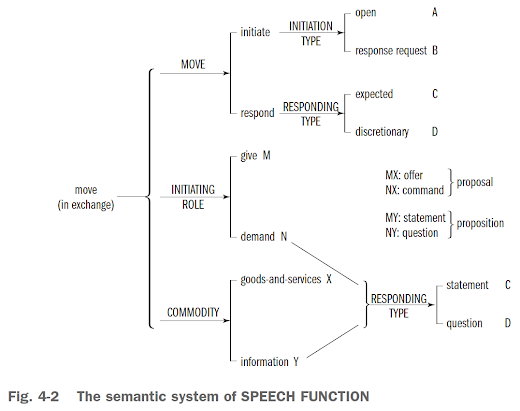
[2] This is misleading, because it is not true. The system of SPEECH FUNCTION specifies both initiating and responding moves. Halliday (1985: 69) listed the responses as follows:

and Halliday & Matthiessen (2004: 108) later provided the following system network:

Misrepresenting Stratification [Augmented]

Martin (1992: 46):
To this point a stratified approach to the function of interacts has been proposed, with MOOD and SPEECH FUNCTION each contributing one layer of meaning on the content plane.


Blogger Comment:

[1] This is misleading, because it misrepresents Halliday's prior theorising as Martin's innovation. To be clear, firstly, Martin is claiming in this publication that stratifying the content plane is his innovation, despite the fact that Halliday & Hasan (1976: 5) present just such a stratification:
And secondly, Martin is here claiming that stratifying SPEECH FUNCTION (semantics) with respect to MOOD (lexicogrammar) is his innovation, despite this distinction being made in Halliday (1985: 71, 342), if not before:
The semantic function of a clause in the exchange of information is a proposition; the semantic function of a clause in the exchange of goods-&-services is a proposal. …
The other main type of interpersonal metaphor is that associated with mood. Mood expresses the speech function; and as we saw in Chapter 4 the underlying pattern of organisation here is the exchange system — giving or demanding information or goods-&-services, which defines the four basic speech functions of statement, question, offer and command.
[2] In SFL stratification, the content plane consists of one level of meaning, semantics, and one level of wording, lexicogrammar, not two levels of meaning. The grammatical system of MOOD is a system of wording that realises meaning: the semantic system of SPEECH FUNCTIONThe semantic system of SPEECH FUNCTION is a system of meaning that is realised by wording: the grammatical system of MOOD.

Saturday, 25 April 2015

Misrepresenting The Potential Of Ellipsis To Negotiate Attitude [New]

Martin (1992: 45):

Significantly, attitude is not realised through the Mood function in English, unlike MODALISATION and MODULATION which can be expressed through modal verbs and adjuncts. For this reason ellipsis in English does not facilitate the negotiation of attitude — the attitude to be graded is commonly realised in the Residue itself. 
It thus follows from the grammar that how a speaker feels is less commonly negotiated through pair parts in dialogue than is inclination, obligation, probability and usuality and that where it is negotiated, MODALISATION and MODULATION are typically being negotiated as well since the Mood element is normally present (cf. Yes he is rather above).


Blogger Comments:

[1] The argument here is:

Premiss: attitude is realised in the Residue not the Mood element
Conclusion: ellipsis does not facilitate the negotiation of attitude

To be clear, this is a false conclusion invalidly argued from a false premiss. The premiss is false because attitude can be realised in the Mood element as well as the Residue, as demonstrated by:

The conclusion is false because ellipsis can "facilitate the negotiation of attitude", as demonstrated by exchanges like:

Is he scrupulously honest?
— No, he isn't scrupulously honest.
— Yes, he is scrupulously honest
The argument is invalid because the location of attitude in the clause, has no bearing on whether or not ellipsis can "facilitate the negotiation of attitude".

[2] To be clear, this does not follow from the grammar, see [1] above. Moreover, it is bare assertion, unsupported by evidence from corpora.

[3] The argument here is:

Premiss: the Mood element is normally present.
Conclusion: MODALISATION and MODULATION are typically being negotiated.

To be clear, this argument is invalidated by clauses that normally feature a mood element, but don't typically negotiate modality, such as:


The reason why Martin thinks that all negotiation is the negotiation of modality is that he (p39) misunderstands modality as including positive and negative polarity, rather than just the space between them.

The Line Between Exclamations and Statements [New]

Martin (1992: 43-5):
This raises the question of how to draw the line between Exclamations and Statements. On the one hand, exclamatives have affirmative syntax (Subject^Finite) and so are definitely negotiable; at the same time, declarative clauses may encode reaction through attitudinal adjuncts (e.g. regrettably) or through group rank systems (e.g. can't stand and silly bugger). The strategy developed here will be to treat attitudinal minor clauses and exclamatives as Exclamations:
Exclamation [minor/exclamative]     What a fooI!/What a fool he's been!
Response to Exclamation                  — Quite so.
and to include other MOOD classes only where attitude is explicitly graded in a response:
Statement [declarative]      He's been such a fool.
Acknowledge Statement     — Oh, has he?
But:
Exclamation [declarative]     He's been such a fool.
Response to Exclamation     — Absolutely.
The relevant section of the MOOD network needs to be adjusted as follows, incorporating the feature [exclamative] and adding the feature [affirmative] to generalise across the Subject^Finite st[r]ucture in both exclamative and declarative clauses.


Blogger Comments:

[1] To be clear, exclamations and statements are speech functions at the level of semantics, whereas exclamatives and declaratives are mood types at the level of lexicogrammar. The "line between" exclamations and statements is semantic, not lexicogrammatical.

[2] To be clear, "encoding reaction through attitudinal adjuncts" is irrelevant here because it does not distinguish either speech functions or mood types. For example:
Exclamation [realised as exclamative]     What a fool he's been!
Acknowledgement                                       — Regrettably so.
Statement [realised as declarative]      He's been such a fool.
Acknowledgement                                   — Regrettably so

[3] On the one hand, this is a non-sequitur, since it is not entailed as a conclusion by the preceding propositions. On the other hand, the realisation of exclamations (semantics) as exclamative clauses or by minor clauses (lexicogrammar) is Halliday's model; see Halliday (1985: 84-5; 1994: 84, 95).

[4] To be clear, this is a statement, not an exclamation. The exclamatory response absolutely has no bearing on the speech function of this initiating clause, since it can be used to respond to either statements or exclamations, as well as questions (yes/no), commands and offers.

[5] To be clear, this MOOD network does not address the "line between exclamations and statements", the question raised at the beginning of this section, and does not address the realisation of exclamations as either exclamative or minor clauses, not least because it does not include minor clauses as an option.

Greetings and Calls [New]

Martin (1992: 42):
Minor clauses lack Subject, Finite and Predicator functions, so the question of negotiating MODALISATION and MODULATION does not directly arise. This raises the question of the function of minor clauses as interacts. For one thing, minor clauses are used to initiate two types of adjacency pair: Greetings and Calls. Greetings (subsuming leave-takings) are found at the beginning and end of conversations, making way for or closing down negotiations:
Greeting                             G'day.
Response to Greeting       — G'day.
Calls summon the attention of potential negotiators where this attention has not been secured or has wandered:
Call                                     Bill.
Response to Call               — What?
Both Calls and Greetings can be realised through major clauses, although these are for the most part lexicalised formulas: How's it going?, Nice weather we're having!, We'll be seeing you., Got a minute?, Listen to this. etc.


Blogger Comments:

[1] As previously observed, MODALISATION and MODULATION are only potentially "negotiated" in clauses that feature MODALISATION and MODULATION, and not all exchanges involve negotiation.

[2] To be clear, this question had already been answered by Halliday in Dimensions of Discourse Analysis (1985), where minor clauses were said to realise minor speech functions: exclamations, calls, and greetings. Here Martin once again misleads the reader into thinking that this is his original thinking.

Misrepresenting Nonfinite Clauses [New]

Martin (1992: 42):
With nonfinite clauses, meaning is presented not so much as having been negotiated as non-negotiable: the clauses have been nominalised, and thereby taken out of the realm of potential interacts and into that of things (cf. They watched Manly winning/the game/their favourite player).


Blogger Comments:

This seriously misunderstands nonfinite clauses. Although his MOOD network (Fig 2.6) contrasts nonfinite clauses with dependent and embedded clauses, Martin here presents an embedded nonfinite clause, while, at the same time, ignoring the possibility of nonfinite dependent clauses.

To be clear, nonfinite clauses may be ranking (dependent) or embedded, and it is only embedded nonfinite clauses that are nominalised to served as the Head or Postmodifier of a nominal group. Examples of ranking dependent clauses include:

  • The hairy coat holds a layer of air close to the skin, insulating the body against changes in the outside temperature. [elaboration]
  • We used to go away at the weekend, taking all our gear with us. [extension]
  • Bacteria can also aid chemical precipitation of calcite by making the water more alkaline. [enhancement: manner]
  • This view was not empirically based, having arisen from an a priori philosophy. [enhancement: cause]
See Halliday & Matthiessen (2014: 468, 475, 485).